
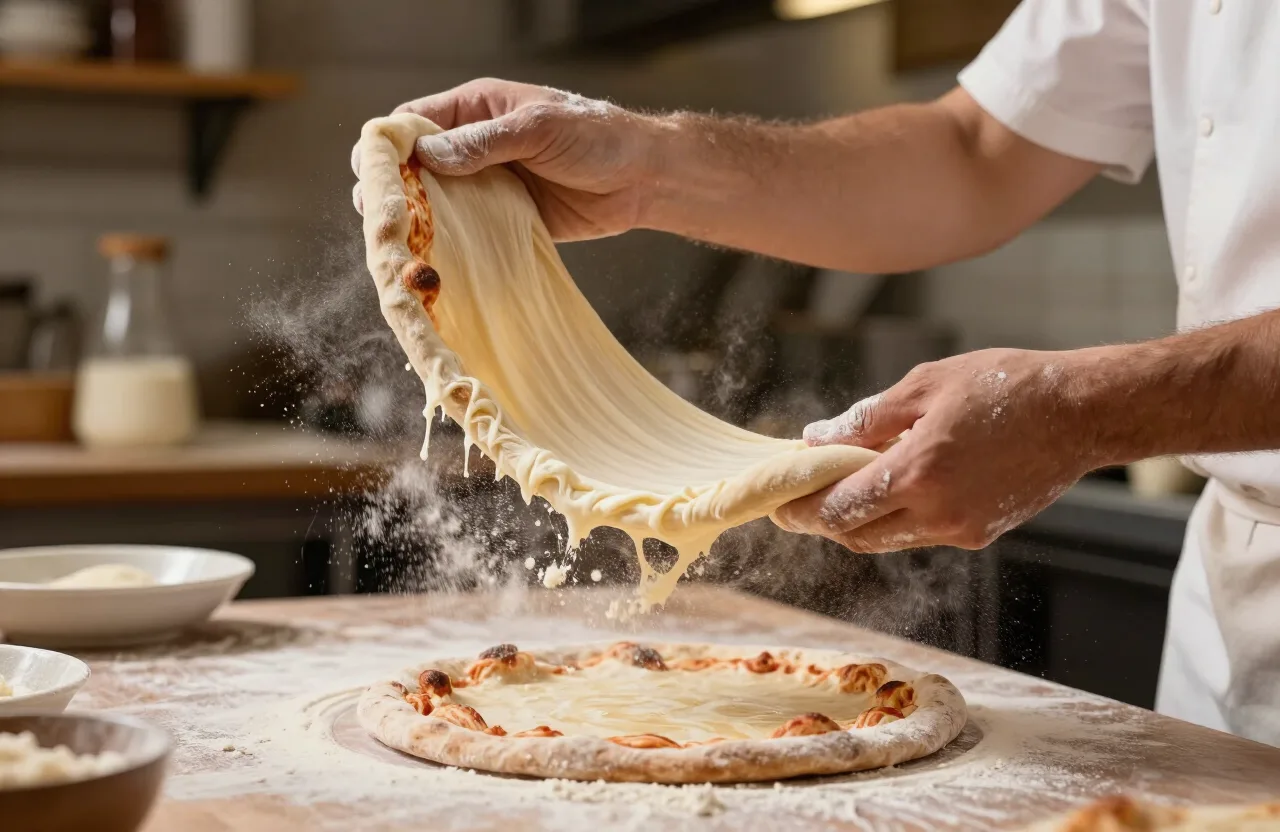
What is hand tossed pizza?
Tossing stretches the dough with centrifugal force while preserving the gas bubbles that give a light, airy crumb. Because it isn't rolled or docked, a hand tossed crust keeps a puffier rim and more irregular, artisan character.
Hand tossed vs pan pizza
Pan pizza proofs and bakes in an oiled pan, giving a thick, fried, uniformly crisp base. Hand tossed is thinner, chewier, and baked directly on a stone or deck. If you want crunch and richness, choose pan; for a classic pizzeria bite, choose hand tossed.
How to stretch dough by hand
Start from a well-proofed ball, press outward from the center leaving the rim thick, then drape the dough over your knuckles and rotate to let gravity do the stretching. Tossing comes with practice — it's mostly for even thinning, not showmanship.
Hand-tossed versus pan and thin-crust
On a pizzeria menu, 'hand-tossed' sits between thin-crust and pan pizza. It's stretched by hand (and sometimes actually tossed in the air) into a medium-thickness round with a raised, airy rim and a crust that's crisp outside and chewy inside. Pan pizza is thicker and fried against an oiled pan; thin-crust is rolled or pressed flatter and crisper throughout. Hand-tossed is the everyday, all-purpose style most home cooks are aiming for.
Why cooks toss the dough
Tossing isn't just showmanship. Spinning the dough in the air uses centrifugal force to stretch it evenly without the crushing pressure of a rolling pin, preserving the gas bubbles that make the crust light. The gentle stretch also builds an even thickness and a naturally raised edge. That said, you don't need to toss - hand-stretching on the counter achieves the same result with less risk of a dough on the floor.
- Press from the center out, leaving a raised rim untouched.
- Stretch over your knuckles and rotate to thin it evenly.
- Let gravity help by draping the dough and turning it.
- Keep the work surface lightly floured to prevent sticking.
The right dough for hand-tossing
Hand-tossed dough needs enough strength to stretch thin without tearing and enough extensibility to relax under your hands. A bread-flour dough around 60-63% hydration with a good proof hits that balance. Under-proofed dough snaps back and resists stretching; well-proofed dough opens up smoothly and holds its shape.
Baking a hand-tossed pie at home
Bake hand-tossed pizza on a preheated steel or stone at your oven's highest setting, typically 500-550°F, for eight to ten minutes until the rim is golden and the base is crisp. The medium thickness is forgiving, making this the best style for beginners to master before moving on to blistering-hot Neapolitan or cracker-thin tavern pies.
Fixing dough that won't stretch
If your dough keeps springing back, it's telling you it needs to relax. Cover it and rest it for 10-15 minutes, then try again - the gluten will have loosened. Cold dough is also stubborn, so let refrigerated dough warm toward room temperature before shaping. Never force it or resort to a rolling pin; patience and a short rest solve nearly every stretching problem.
Hand-tossed toppings and bake
The medium-thick hand-tossed base can carry a bit more topping than a thin crust without going soggy, but the same rules apply: keep wet ingredients in check and leave the raised rim bare so it can puff and brown. Bake on a preheated steel or stone at 500-550°F for eight to ten minutes, and finish under the broiler for the last minute if you want extra color on the cheese and crust.
Why hand-tossed is the best style to learn on
Hand-tossed pizza is the ideal training ground because its medium thickness forgives small mistakes that would ruin a thin or high-heat pie. The dough is strong enough to handle without tearing, the bake temperature is achievable in any home oven, and the raised rim gives you room for error on your stretch. Master hand-tossed first and you'll have the dough handling, launching, and baking instincts that every other style depends on.
Frequently Asked Questions
What does hand tossed pizza mean?
It means the dough was stretched and shaped by hand rather than pressed in a pan or rolled flat, giving a chewy, medium-thick crust.
Is hand tossed or pan pizza better?
Hand tossed is thinner and chewier; pan pizza is thicker and crispier. It comes down to preference for crunch versus a classic bite.
Is hand tossed pizza thin crust?
It's between thin and pan — thinner than pan pizza but with a puffier rim than true thin crust.
Do you have to toss the dough in the air?
No. The 'toss' is really about even stretching; you can achieve the same result draping and rotating the dough over your knuckles.