
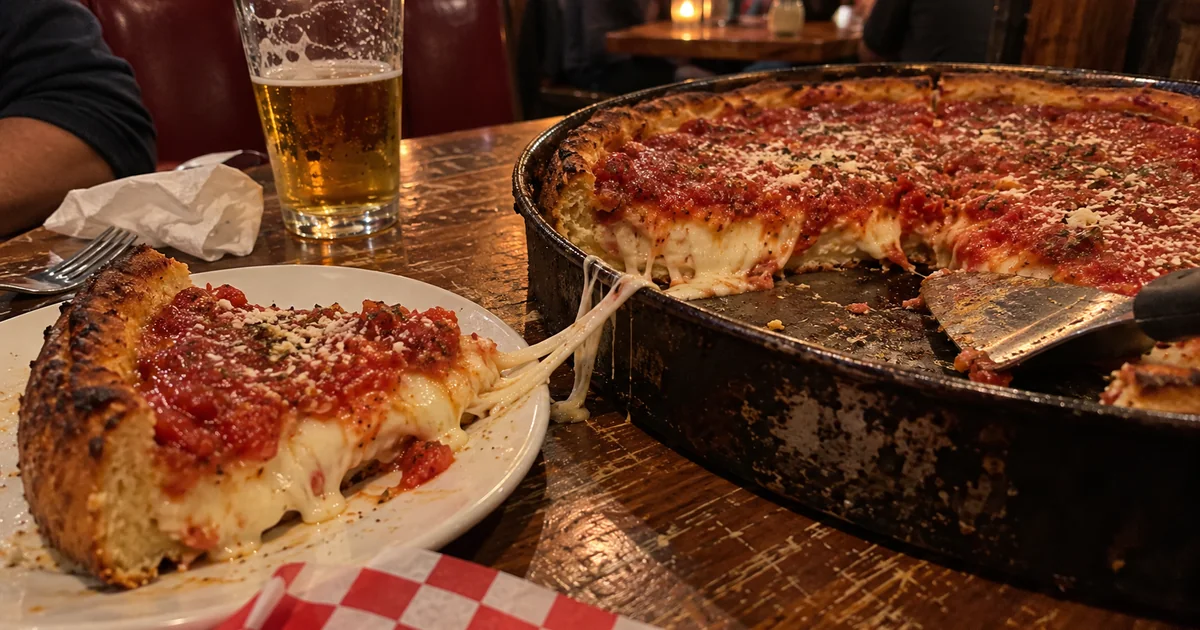
What is deep dish pizza?
Deep dish pizza is defined by the pan and the layer order. The pan is round, seasoned steel, usually 9 or 12 inches across and 2 inches deep, and it is oiled generously so the crust fries against the metal as it bakes. The dough is pressed, not stretched, across the bottom and up the sides to form a bowl. Into that bowl go the layers in reverse of what the rest of the country expects: cheese first, then sausage or other toppings, then tomato sauce on top, finished with grated parmesan.
The reason for the upside-down order is the long bake. A pie this deep needs 30 to 45 minutes at 425 to 450°F to cook through, and mozzarella on top for that long would burn. Putting the cheese underneath protects it, and the sauce on top, which is really just drained crushed tomatoes, slowly reduces in the oven instead of making the crust wet. The result is more like a savory pie than a flatbread, which is why the eternal argument about whether it counts as pizza never ends.
Deep dish pizza spec
The same card we use for every style in the atlas; scale any number in the dough calculator.
- Flour: all-purpose or bread flour, about 11.5 to 12.5 percent protein
- Hydration: 55 to 60 percent, a stiff, pliable dough
- Fat: 10 to 15 percent, corn oil or a mix of oil and butter; some versions laminate butter into the dough for a flakier wall
- Sugar: 1 to 2 percent
- Salt: 2 percent
- Yeast: 1 to 1.5 percent instant, same-day rise
- Ferment: 1.5 to 2 hours at room temperature, or overnight in the fridge for more flavor
- Dough weight: about 550 grams for a 9-inch pan, 900 grams for a 12-inch
- Pan: seasoned steel deep dish pan or a 9 to 10-inch cast iron skillet, 2 inches deep, oiled
- Layer order: dough, sliced low-moisture mozzarella, toppings, crushed tomatoes, parmesan
- Cheese: sliced low-moisture mozzarella, about 225 grams for a 9-inch pie
- Sauce: drained crushed tomatoes with salt, oregano and garlic, uncooked
- Bake: 425 to 450°F, 30 to 45 minutes, until the crust is deep golden and the center reads 190°F
- Rest: 10 minutes in the pan before cutting
- Cut and serve: 6 to 8 wedges, eaten with a knife and fork
- Origin: Chicago, 1943
Where deep dish pizza came from
Deep dish was invented in Chicago in 1943 at Pizzeria Uno, on the corner of Ohio and Wabash, opened by Ike Sewell and Ric Riccardo. Who actually developed the recipe is disputed; the restaurant's cook, Rudy Malnati Sr., is often credited, and his family went on to found Pizzeria Due, Lou Malnati's and Pizano's, which is why the Malnati name is still attached to the style. Gino's East opened in 1966 with its own version, famous for a golden cornmeal-colored crust and walls covered in customer graffiti.
Stuffed pizza, the deep dish's taller cousin, arrived in the 1970s. Nancy's and Giordano's both claim it, opening in 1971 and 1974 respectively with a pie that adds a second thin layer of dough over the cheese and toppings before the sauce goes on. Stuffed is the version tourists often photograph, because the cheese pull is bigger, but deep dish is the original.
The style spread nationally in the 1980s and 1990s through Uno's franchising and frozen pizza, and today most Americans outside Illinois meet deep dish in a chain or a supermarket freezer before they meet the real thing. Our guide to the best pizza in Chicago covers where to eat it in the city.
Chicago style pizza: deep dish, stuffed, pan and tavern
"Chicago style pizza" means deep dish to the rest of the country, but Chicago itself eats four different pizzas, and the one most Chicagoans order on a weeknight is the thin one. Here is how they differ.
| Deep dish | Stuffed | Pan pizza | Tavern style | |
|---|---|---|---|---|
| Depth | About 1.5 inches of filling in a 2-inch pan | 2 to 3 inches, the tallest | About 1 inch | Cracker thin |
| Crust | Pressed, buttery, biscuit-like wall | Same wall, plus a thin top layer of dough under the sauce | Thick, bready, fried bottom | Rolled thin, docked, crisp |
| Layer order | Cheese, toppings, sauce on top | Cheese and toppings, dough lid, sauce on top | Sauce, then cheese, then toppings | Sauce, cheese, toppings |
| Bake | 425 to 450°F, 30 to 45 minutes | 425°F, 45 to 60 minutes | 450 to 500°F, 15 to 20 minutes | 500°F or more, 10 to 12 minutes |
| Cheese | Sliced low-moisture mozzarella | Heavy layer of sliced mozzarella | Shredded mozzarella | Thin layer of shredded mozzarella |
| How it is cut | 6 to 8 wedges | 6 to 8 wedges | Wedges | Squares, the party cut |
| How it is eaten | Knife and fork | Knife and fork | By hand | By hand, at a bar |
| Where to get it | Uno, Lou Malnati's | Giordano's, Nancy's | Chain pan pizza, Detroit relatives | Vito and Nick's, neighborhood taverns |
Deep dish and stuffed are what visitors order. Tavern style pizza is what locals order, and our Chicago guide explains the split. If you want the opposite end of the spectrum from sauce-on-top, the New York style pizza page is the thin, foldable answer.
What makes a deep dish crust different
A deep dish crust is closer to a savory pie crust than to bread. Three things set it apart. First, the fat: 10 to 15 percent oil or butter, several times what goes into a New York dough, which tenderizes the crumb and lets the wall hold its shape against the pan. Second, the handling: the dough is pressed into the pan with fingertips, never stretched or tossed, so it stays dense and even. Third, the oil in the pan, which fries the bottom and sides into a crisp, golden shell while the inside stays soft. Some recipes laminate butter into the dough in a couple of folds, which gives the wall visible flaky layers; Uno's does not, but many home bakers prefer it.
Despite the color, classic deep dish dough does not usually contain cornmeal. The yellow comes from corn oil and, in some kitchens, a little butter. Cornmeal is a common addition in home recipes for crunch and is not wrong, just not original. Our pizza dough recipes page explains what each ingredient does.
Why the cheese goes on the bottom
Every deep dish is built in the same order for the same reason: time in the oven. Sliced mozzarella goes straight onto the dough, where it melts into a solid layer and seals the crust from the wet ingredients above it. Sausage goes on next, raw, as a single flattened patty covering the whole pie, so it cooks in the oven and its fat flavors the cheese. Then the tomatoes: a can of crushed or hand-crushed whole tomatoes, drained well, seasoned with salt, oregano and garlic, spread to the edge. A dusting of grated parmesan or pecorino on top browns during the bake. The sauce is never cooked first; 40 minutes in the oven does that. Our best cheese for pizza guide covers why it has to be low-moisture mozzarella and why slices beat shreds here.
Deep dish pizza pan: what to use
A proper deep dish pizza pan is dark seasoned steel, 2 inches deep, with straight sides, and it costs less than a baking steel. It bakes a slightly crisper wall than cast iron because it is thinner and heats faster. A cast iron skillet is the best substitute and what most home cooks should start with; a 9-inch round cake pan with 2-inch sides also works if it is heavy. Avoid springform pans, which leak oil, and glass, which browns the bottom poorly. Whatever you use, oil it more than feels reasonable. The oil is what makes the crust.
How long to bake deep dish pizza
Count on 30 to 45 minutes at 425 to 450°F, depending on pan size and how full it is. A 9-inch pie is done around 32 minutes; a 12-inch pie needs 40 to 45. The two tests that matter: the crust wall should be deep golden brown and visibly shrinking from the pan, and the center of the pie should be hot all the way through, which a thermometer confirms at 190°F in the crust. If the top is darkening before the center is hot, tent it loosely with foil for the last 10 minutes. Under-baked deep dish, with a pale wall and a soft bottom, is the single most common failure.
Reheating deep dish
Deep dish reheats better than almost any pizza because the crust is sturdy and the filling is deep. The right method is the oven, not the skillet: 350°F, slices on a sheet pan or back in the pan, covered with foil for 15 minutes and uncovered for the last 5 so the wall re-crisps. Air fryers work for one slice at a time at 325°F for 8 to 10 minutes. The microwave turns the crust to sponge. Our how to reheat pizza guide has timings for every style.
Is deep dish really pizza?
The argument is older than most of the people having it. Critics say a pie with the sauce on top, eaten with a fork, is a casserole; defenders say the definition of pizza is dough, cheese and tomato baked together, and deep dish qualifies on all three. The honest answer is that it is a different food from a New York slice and should be judged as one. It is also worth knowing that deep dish is a special-occasion pie even in Chicago; the city's everyday pizza is tavern style, thin and cut in squares. If you are planning a trip, order one of each and settle the argument yourself.
Common deep dish mistakes
Shredded cheese instead of slices, which melts unevenly and lets sauce through to the crust. Wet sauce: the tomatoes must be drained, or the pie steams. A cold oven or a pan placed too high, which gives a pale bottom. Pulling it early because the top looks done; the wall color is the real signal. And overfilling: a 9-inch pan holds 225 grams of cheese and 225 grams of sausage comfortably and no more. Deep dish is forgiving on technique and unforgiving on moisture.
Chicago deep dish pizza recipe (cast iron skillet)
This chicago deep dish pizza recipe is sized for a 9 or 10-inch cast iron skillet, which is the pan most people already own and which does the job as well as a steel deep dish pan. It serves 4. For a 12-inch pan, multiply everything by 1.6 in the dough calculator.
Yield: One 9-inch deep dish pizza, 6 wedges, serves 4
Ingredients
- •300g all-purpose flour
- •170g lukewarm water (57% hydration)
- •40g corn oil, plus 2 tablespoons more for the pan
- •25g unsalted butter, softened
- •6g fine sea salt
- •6g sugar
- •4g instant yeast
- •225g low-moisture mozzarella, sliced, not shredded
- •225g raw bulk Italian sausage
- •1 can (400g) whole peeled tomatoes, drained and crushed by hand
- •1 clove garlic, grated, 1 teaspoon dried oregano, 1/2 teaspoon salt for the tomatoes
- •20g grated parmesan or pecorino
Method
- 1Stir the yeast and sugar into the water. Add the flour and salt, then the corn oil, and mix into a soft dough. Knead 5 minutes until smooth; it will feel richer and less elastic than a bread dough.
- 2Flatten the dough into a rectangle, spread the softened butter over it, fold it in thirds like a letter, then in thirds again. Round it, cover, and rise 1.5 to 2 hours until doubled. For more flavor, refrigerate overnight instead and take it out 1 hour before shaping.
- 3Heat the oven to 425°F with a rack in the lower third. Pour 2 tablespoons of corn oil into the skillet and swirl it up the sides.
- 4Press the dough into the skillet with your fingertips, working from the center out and then up the wall to about 1.5 inches. Let it rest 10 minutes if it springs back, then press again.
- 5Lay the mozzarella slices over the bottom in an overlapping layer. Flatten the sausage into a thin patty the size of the pan and lay it over the cheese.
- 6Mix the crushed tomatoes with the garlic, oregano and salt, and spoon them over the sausage right to the edge. Do not add extra liquid. Sprinkle the parmesan over the top.
- 7Bake 30 to 35 minutes, until the crust wall is deep golden and pulling from the pan and the tomatoes have darkened at the edges. A thermometer in the center should read 160°F for the sausage and the crust 190°F or more.
- 8Rest 10 minutes in the pan. Run a knife around the edge, slide the pie onto a board, and cut into 6 wedges with a sharp knife.
Frequently Asked Questions
What is deep dish pizza?
Deep dish pizza is a Chicago style pizza baked in a 2-inch-deep oiled steel pan, with a buttery pressed crust, sliced mozzarella on the bottom, toppings in the middle and chunky tomato sauce on top. It bakes 30 to 45 minutes and is eaten with a knife and fork.
What is the difference between deep dish and stuffed pizza?
Stuffed pizza adds a second thin layer of dough over the cheese and toppings before the sauce goes on, so it is taller and holds more cheese. Deep dish has one crust with the sauce directly on the toppings. Deep dish dates to 1943; stuffed to the 1970s.
Why is the sauce on top of deep dish pizza?
Because the pie bakes for 30 to 45 minutes, and cheese on top would burn. Putting the mozzarella under the toppings protects it, and the drained tomatoes on top reduce slowly in the oven without soaking the crust.
How long does deep dish pizza take to bake?
30 to 45 minutes at 425 to 450°F. A 9-inch pie is done in about 32 minutes; a 12-inch pie needs 40 to 45. The crust wall should be deep golden and the center hot all the way through.
Can you make deep dish pizza in a cast iron skillet?
Yes. A 9 or 10-inch cast iron skillet is the best substitute for a steel deep dish pan. Oil it generously, press the dough up the sides to about 1.5 inches, and bake at 425°F for 30 to 35 minutes.
What is Chicago style pizza?
Outside Chicago the phrase means deep dish. In Chicago it covers four pizzas: deep dish, stuffed, pan and the thin, square-cut tavern style that locals eat most often.
Where was deep dish pizza invented?
At Pizzeria Uno in Chicago in 1943, founded by Ike Sewell and Ric Riccardo. The recipe is often credited to the restaurant's cook, Rudy Malnati Sr., whose family later founded Lou Malnati's.