
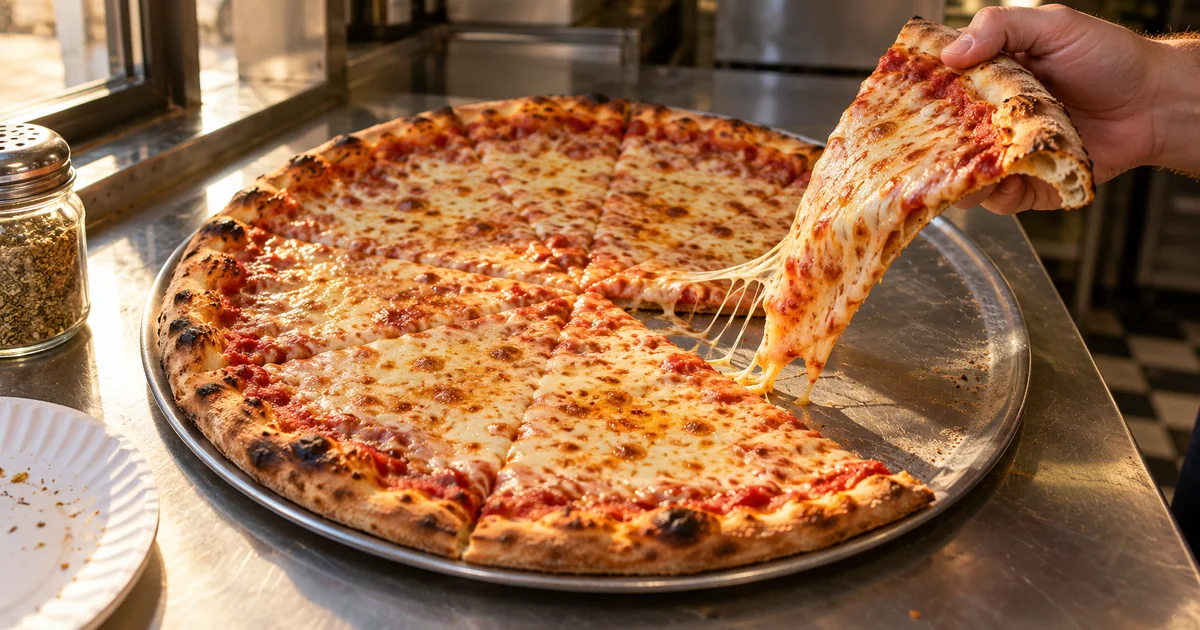
What is New York style pizza?
A New York slice is defined by four things: size, structure, cheese and bake. The pie is big, 18 inches at most slice shops and never smaller than 16, which is why one slice is a meal. The crust is thin in the middle but not cracker-thin; it has enough chew and strength to be folded lengthwise without cracking, with a slim rim that blisters but stays soft. The cheese is low-moisture mozzarella, aged and often whole-milk, which melts into a smooth sheet with the brown spots and light slick of orange oil that are part of the look. And it is baked in a gas deck oven at 550 to 600°F for 12 to 15 minutes, long enough to crisp the bottom and brown the cheese, which is a slower, cooler bake than Neapolitan pizza gets.
The result is a pizza built for selling by the slice. It reheats well, holds its shape on a paper plate, and tastes right at any temperature from oven-hot to lukewarm. If you have ever bought a slice through a window and folded it on the sidewalk, you have had the real thing.
New York style pizza dough spec
This is the card we use for every style in the atlas, so you can compare New York to Neapolitan or Detroit line by line. Open any number in the dough calculator to scale it.
- Flour: high-gluten bread flour, 12.7 to 14.2 percent protein (All Trumps, King Arthur Sir Lancelot or a strong bread flour)
- Hydration: 60 to 65 percent
- Oil: 2 to 3 percent olive or vegetable oil
- Sugar: 1 to 2 percent (browning at a deck-oven temperature, not sweetness)
- Salt: 2 to 2.5 percent
- Yeast: 0.3 to 0.5 percent instant, for a cold ferment
- Ferment: 24 to 72 hours in the refrigerator, balled
- Ball weight: 560 to 620 grams for an 18-inch pie; about 380 grams for a 14-inch home pie
- Shape: hand-stretched round, thin center, slim rim, no rolling pin
- Sauce: uncooked or briefly cooked crushed tomatoes with salt, oregano and a pinch of sugar
- Cheese: aged low-moisture mozzarella, whole-milk or part-skim, shredded, about 225 grams per 18 inches
- Bake: 550 to 600°F deck oven, 12 to 15 minutes; home oven 550°F on a steel, 6 to 9 minutes
- Cut: 8 slices, triangular, folded to eat
- Origin: New York City, early 1900s, from Neapolitan immigrant bakers
Where New York pizza came from
New York pizza descends directly from Naples, but it changed the moment it arrived. Gennaro Lombardi's grocery on Spring Street in Manhattan was licensed to sell pizza in 1905 and is generally credited as the first pizzeria in the United States. Lombardi baked in a coal-fired oven, not the wood oven of Naples, because coal was what New York had. Coal burns hotter and drier than wood and produces a crisper, more charred crust, which became the first New York signature. Pizzaioli who trained under Lombardi opened the places that still define the old guard: Totonno's in Coney Island in 1924, John's of Bleecker Street in 1929 and Patsy's in East Harlem in 1933.
The slice is a later invention. After the Second World War, gas-fired deck ovens such as the Bakers Pride models made in the Bronx spread through the city because they were cheaper and legal to install where coal ovens were not. Gas decks run cooler than coal, around 550 to 600°F, and a cooler, longer bake produced a sturdier crust that could be baked ahead, held, sold one slice at a time and reheated on the deck. By the 1960s the slice shop was the dominant form, and the pie had grown to 18 inches because a bigger pie meant bigger slices and more of them per oven load. The price of a slice tracked the price of a subway ride for decades, an observation New Yorkers call the Pizza Principle.
The modern New York pizza scene includes a coal-oven revival, the Neapolitan wave of the 2000s and the dollar slice, but the gas-deck, 18-inch, fold-it-in-half slice is the style this page is about.
What makes a New York style pizza crust different
Three ingredients separate New York dough from Neapolitan dough: strong flour, oil and sugar. Neapolitan dough is flour, water, salt and yeast baked in 60 to 90 seconds at 900°F. New York dough has to survive a 12 to 15 minute bake at 550°F and still come out tender, and that is what the extras are for.
High-gluten flour gives the crust its chew and the strength to be stretched to 18 inches without tearing, then folded without snapping. Oil shortens the gluten slightly so the crumb stays tender through the long bake and the bottom fries lightly against the deck. Sugar feeds the yeast during a long cold ferment and, more importantly, browns the crust at a temperature too low to char it the way a wood oven does. A cold ferment of one to three days develops the flavor that a quick same-day dough cannot reach. Our general guide to pizza dough recipes covers how these levers work across styles; the recipe below is the New York setting of each one.
New York vs Neapolitan pizza
| New York style | Neapolitan | |
|---|---|---|
| Size | 16 to 18 inches, 8 slices | 10 to 12 inches, eaten whole |
| Flour | High-gluten, 12.7 to 14% protein | Italian 00, about 12% |
| Oil and sugar | Yes | No |
| Hydration | 60 to 65% | 58 to 65% |
| Cheese | Aged low-moisture mozzarella | Fresh mozzarella or fior di latte |
| Oven | Gas deck, 550 to 600°F | Wood, 850 to 950°F |
| Bake time | 12 to 15 minutes | 60 to 90 seconds |
| Crust | Thin, chewy, crisp bottom, foldable | Soft, puffy rim, wet center, knife and fork |
| Eaten | By the slice, folded, often reheated | Whole, immediately |
The practical difference for a home cook is the oven. Neapolitan needs 850°F and a dedicated pizza oven. New York style needs 550°F and a baking steel, which is why it is the style we recommend for a standard kitchen oven. See our pizza steel vs stone comparison for why the steel matters at this temperature.
New York vs Brooklyn style, New Haven and the New York square
Brooklyn style pizza is a chain-menu term, not a style with a history. It describes a thinner, crisper, cornmeal-dusted crust cut into six wide slices; our Brooklyn style pizza page explains where the name came from. New Haven style pizza, or apizza, is the coal-oven cousin from Connecticut: oblong, charred, chewy, with grated pecorino instead of mozzarella unless you ask. The New York square, sold at the same counter as the round slice, is a Sicilian pizza baked in an oiled pan with a thick, airy crumb; it is a different dough and a different page. Hand tossed pizza is the chain-menu name for a crust in the New York family that has been softened for a conveyor oven.
The New York water myth
Many New Yorkers believe the city's soft Catskill water is the reason the pizza cannot be reproduced elsewhere. Water chemistry does affect dough a little, since very hard water tightens gluten and very soft water loosens it, but the effect is small next to flour protein, hydration, fermentation time and oven heat. Blind bake tests run by food writers using shipped New York water against local tap water have found differences that tasters could not reliably pick out. If your New York pizza does not taste like New York pizza, the oven and the flour are the first things to check, not the tap.
The sauce and the cheese
New York sauce is simple on purpose. Good canned crushed tomatoes, salt, dried oregano and a pinch of sugar, either uncooked or simmered for ten minutes, spread thin enough that the crust still shows through in places. The five-minute no-cook sauce on our pizza sauce page is a New York sauce. Too much sauce, or a sweet, herb-heavy sauce, is the fastest way to make a pie taste like a chain.
The cheese does more work here than in any other style. Fresh mozzarella releases water and floods a long bake; New York slices use aged low-moisture mozzarella, shredded, because it melts evenly, browns in spots and releases the small amount of oil that gives a slice its sheen. Whole-milk is richer and browns faster, part-skim is drier and holds up better on a slice that will be reheated. Most New York shops use one or the other from a handful of commercial brands. Our best cheese for pizza guide covers what to buy and why pre-shredded bags melt badly.
How to bake New York style pizza in a home oven
The gap between a home oven and a slice-shop deck is heat from below, and a baking steel closes most of it. Steel conducts heat far faster than stone, so a 550°F steel crisps the bottom in the seven or eight minutes before the cheese burns. Put the steel on an upper-middle rack rather than the bottom so the top gets radiant heat from the roof of the oven, preheat for at least 45 minutes, and launch the pizza with semolina on the peel. Bake one pie at a time and give the steel five minutes between pies to recover.
If you only have a stone, bake on the lowest rack and expect 10 to 12 minutes and a slightly softer bottom. If you have neither, a heavy inverted sheet pan preheated the same way is better than a cold pan. Our guide to pizza ovens covers the next step up: an outdoor oven turned down to 600°F makes a near-perfect New York pie.
Reheating a New York slice
Day-old New York pizza is a feature, not a flaw, and the style was built to be reheated. The best method is a dry skillet over medium heat with a lid for the last minute, which re-crisps the bottom while the cheese softens; a 400°F oven on a steel or stone for 5 minutes is a close second. The microwave turns the crust to rubber. Our how to reheat pizza guide has timings for every method, and our how long is pizza good for page covers how long a slice is safe in the fridge.
Common mistakes with New York style pizza
The first mistake is weak flour. All-purpose flour makes a crust that tears at 14 inches and bakes up soft rather than chewy; use bread flour at minimum. The second is skipping the cold ferment; a same-day New York dough tastes flat and bakes pale. The third is an oven that is not hot enough or a steel that is not hot enough, which produces a bottom that bends instead of cracking at the fold. The fourth is fresh mozzarella, which turns the center into soup over a long bake. And the fifth is a rolling pin, which crushes the rim and turns a New York pie into a cracker. Stretch by hand; it takes three tries to learn and you never forget it.
New York pizza dough recipe
This is the New York style pizza dough we bake in a home oven on a steel. It makes two 14-inch pizzas, which is the largest round most home ovens and steels will take. For an 18-inch pie in a deck oven, scale the same percentages to a 590 gram ball in the dough calculator.
Yield: Two 385 gram dough balls, two 14-inch pizzas
Ingredients
- •450g high-gluten or bread flour
- •284g cool water (63% hydration)
- •9g fine sea salt
- •9g sugar
- •14g olive oil
- •2g instant yeast (a little over half a teaspoon)
Method
- 1Whisk the yeast and sugar into the water. Add the flour and salt and mix until no dry flour remains. Rest 20 minutes.
- 2Add the oil and knead 8 to 10 minutes by hand or 6 minutes in a mixer until smooth, elastic and slightly tacky. High-gluten flour takes longer to come together than all-purpose; keep going.
- 3Divide into two 385g balls, round them tightly, and place each in a lightly oiled covered container.
- 4Cold ferment in the refrigerator for 24 to 72 hours. Day two is the sweet spot for flavor and handling.
- 5Take the dough out 1.5 to 2 hours before baking. Put a baking steel on the upper-middle rack and heat the oven to its maximum, usually 550°F, for a full 45 minutes.
- 6Stretch each ball to 14 inches on a floured counter, pressing the air toward the rim and letting gravity do the rest over your knuckles. No rolling pin; it flattens the rim.
- 7Top with 80g sauce in a thin layer, 140g shredded low-moisture mozzarella, and a pinch of oregano. Launch onto the steel.
- 8Bake 6 to 9 minutes until the cheese is spotted brown and the bottom is crisp and golden. For extra browning on top, switch to broil for the last 60 seconds and watch it.
- 9Rest 2 minutes on a rack so the bottom stays crisp, cut into 8, and fold.
Frequently Asked Questions
What is New York style pizza?
New York style pizza is a large, thin, hand-stretched round pie, typically 18 inches and cut into 8 foldable slices, made with high-gluten dough that contains a little oil and sugar, a light tomato sauce and aged low-moisture mozzarella, baked in a gas deck oven at 550 to 600°F.
What is the difference between New York and Neapolitan pizza?
Neapolitan pizza is small, soft and baked in 60 to 90 seconds at 850°F or more with fresh mozzarella and no oil or sugar in the dough. New York style is larger, firmer and foldable, baked 12 to 15 minutes at 550 to 600°F with aged low-moisture mozzarella and a dough that includes oil and sugar.
Why is New York pizza so big?
Slice shops bake 18-inch pies because a larger pie yields eight generous slices per oven load, which suited selling by the slice as the format spread in the 1950s and 1960s. The thin, strong crust makes a wide slice practical to fold and eat by hand.
Is New York style pizza thin crust?
Yes, but not cracker-thin. The center is thin and the rim is slim, yet the crust keeps enough chew and strength to fold without cracking, which separates it from tavern style or St. Louis thin crust.
What flour is used for New York pizza?
High-gluten flour with 12.7 to 14.2 percent protein, such as All Trumps or a strong bread flour. The extra protein gives the crust its chew and lets it stretch to 18 inches without tearing.
What is the difference between New York and Brooklyn style pizza?
Brooklyn style is a chain-menu term for a thinner, crisper crust cut into six large slices, often dusted with cornmeal. New York style is the traditional 18-inch, eight-slice slice-shop pie with a chewier, foldable crust.
Why do you fold New York pizza?
Folding a slice lengthwise stiffens it so the wide, thin tip does not droop, keeps the toppings in place, and lets you eat it with one hand while walking. It works because the high-gluten crust bends without cracking.