
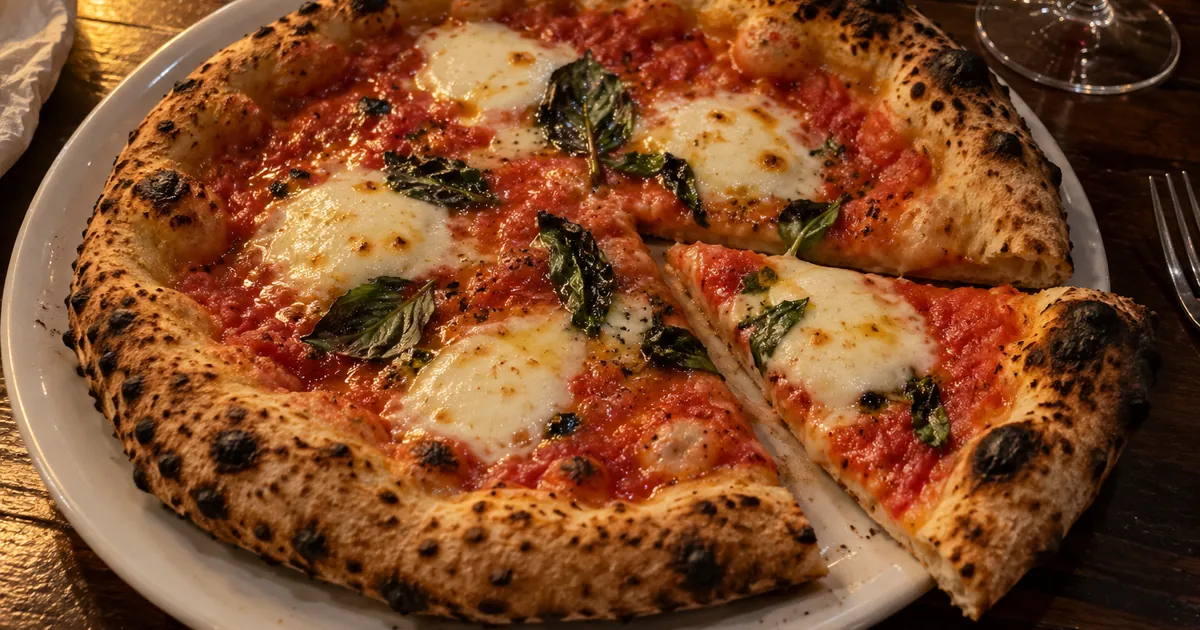
What is a margherita pizza?
A margherita pizza is a Neapolitan pizza with exactly five toppings: tomato, mozzarella, basil, extra virgin olive oil and salt. In Naples it is one of the two pizzas protected by the Associazione Verace Pizza Napoletana rules, the other being the cheeseless marinara, and those rules are specific. The dough is flour, water, salt and yeast only, hand-stretched to no more than 35 cm (about 13 inches) with a raised rim and a center just a few millimeters thick, and baked in a wood-fired oven at 430 to 480°C (805 to 900°F) for 60 to 90 seconds. The result is soft, not crisp: a puffy, blistered rim, a wet center you eat with a knife and fork, and toppings that taste of themselves because nothing in the oven had time to cook them down.
Outside Naples the word is used more loosely. In most American pizzerias "margherita" means any pizza with tomato sauce, fresh mozzarella and basil on whatever crust the shop makes, from a New York round to a flatbread. Both are fine things to eat; this page is about the Neapolitan original and what changes when you take it elsewhere.
What's on a margherita pizza: the ingredients
The margherita pizza toppings never change, which is why the quality of each one matters so much.
Some shops add grated hard cheese (Parmigiano or pecorino) over the tomato, which the AVPN allows. Garlic, oregano, dried basil and pre-shredded cheese do not belong on a margherita, however common they are on an American "margherita".
- Tomato: crushed peeled tomatoes, traditionally San Marzano dell'Agro Sarnese-Nocerino DOP, seasoned with salt only. No cooking, no herbs, no sugar.
- Mozzarella: fior di latte (cow's milk fresh mozzarella) cut into strips, or Mozzarella di Bufala Campana DOP for a "margherita extra". Never low-moisture shredded mozzarella in the Neapolitan version.
- Basil: fresh leaves, a few per pizza, added before the bake in Naples and often after it elsewhere so they stay green.
- Olive oil: extra virgin, poured in a spiral over the top just before the pizza goes in.
- Salt: in the dough and on the tomato.
- Dough: 00 flour, water, salt and yeast. No oil, no sugar.
Margherita pizza dough spec
The dough is Neapolitan dough; this is the same card we use for every style in the atlas. Open any number in the dough calculator to scale it.
- Flour: Italian 00, about 12 to 12.5 percent protein (Caputo Pizzeria is the standard)
- Hydration: 56 to 62 percent
- Oil: none
- Sugar: none
- Salt: 2.5 to 3 percent
- Yeast: 0.05 to 0.2 percent fresh or instant, depending on ferment length
- Ferment: 8 to 24 hours at room temperature in Naples; 24 to 48 hours cold at home works well
- Ball weight: 250 to 280 grams for a 12-inch pizza
- Shape: hand-pressed from the center out, air pushed into a 1 to 2 cm rim, never rolled
- Sauce: crushed San Marzano tomatoes with salt, about 70 grams per pizza
- Cheese: 80 to 100 grams fior di latte or bufala, drained, torn or sliced
- Bake: 430 to 480°C wood oven, 60 to 90 seconds; home oven 550°F on a steel under the broiler, 4 to 6 minutes
- Cut: in Naples, not cut at all; elsewhere, 6 or 8 slices
- Origin: Naples; named in 1889, older than that in practice
Why is it called margherita pizza? The 1889 story and what is actually true
The story every pizzeria tells goes like this. In June 1889, King Umberto I and Queen Margherita of Savoy visited Naples. Raffaele Esposito of Pizzeria Brandi was asked to cook for the queen and made three pizzas; she preferred the one topped with tomato, mozzarella and basil, the red, white and green of the new Italian flag, and Esposito named it in her honor. Brandi still displays a letter of thanks from the royal household dated June 1889.
Historians are less sure. Pizzas topped with tomato, mozzarella and basil appear in Francesco De Bourcard's description of Neapolitan street food published in the 1850s and 1860s, decades before the royal visit, so Esposito did not invent the combination. The historian Zachary Nowak examined the Brandi letter in 2014 and found the seal and signature inconsistent with other royal correspondence of the period, and suggested the story was built up later as the pizzeria's marketing. What is not in doubt is that the name stuck to that exact combination from around the turn of the century, that Naples turned it into the city's signature dish, and that it is now defined by law as a Traditional Speciality Guaranteed across the European Union. Our history of pizza page follows the longer story from Naples to the rest of the world.
Margherita vs Neapolitan, marinara and the American version
People ask whether margherita and Neapolitan pizza are the same thing. Neapolitan is the style; margherita is one of the pizzas within it. Here is how the family lines up.
| Pizza | Tomato | Cheese | Herb | Oven and bake | Where you find it |
|---|---|---|---|---|---|
| Margherita (Neapolitan) | crushed San Marzano | fior di latte | fresh basil | wood, 850 to 900°F, 60 to 90 seconds | Naples and AVPN-certified pizzerias |
| Margherita extra | crushed or fresh cherry tomatoes | mozzarella di bufala | fresh basil | same | Naples; "bufala" on American menus |
| Marinara | crushed San Marzano | none | oregano and garlic | same | the other protected Neapolitan pizza |
| American margherita | cooked pizza sauce | fresh mozzarella slices, sometimes low-moisture underneath | basil, often added after | gas deck or home oven, 500 to 600°F, 6 to 12 minutes | most US pizzerias, flatbread menus |
| New York cheese slice | seasoned cooked sauce | aged low-moisture mozzarella | dried oregano | gas deck, 550°F, 12 to 15 minutes | slice shops; not a margherita |
The practical difference is the cheese and the bake. Fresh mozzarella releases water, and a 90-second bake does not give it time to flood the pizza; a 12-minute bake does, which is why American versions drain the cheese, slice it thin or add it late. Our New York style pizza page covers the slice-shop end of the spectrum.
Margherita pizza recipe for a home oven
This is how to make margherita pizza without a wood oven. A standard kitchen oven tops out around 550°F, and a Neapolitan dough baked at that temperature for 8 minutes comes out pale and dry. The fix is a baking steel under the broiler: the steel cooks the base from below while the broiler element chars the rim from above, and the pizza is done in 4 to 6 minutes. It will not be a 90-second Naples pizza, but it will be a soft, blistered, honest margherita.
The tomatoes, the cheese and the basil
Margherita pizza sauce is not really a sauce. It is good canned whole tomatoes crushed by hand with salt, spread thin enough that the dough shows through. San Marzano tomatoes are worth buying for this pizza specifically because there is nothing to hide behind; look for the DOP seal, since the name on its own is not protected in the United States. Our pizza sauce page explains why cooked sauce belongs on a New York pie and raw tomato belongs here.
The cheese question is fior di latte or bufala. Fior di latte is cow's milk, milder and drier, and it is what most Neapolitan pizzerias use day to day. Buffalo mozzarella is richer, tangier and much wetter, which is why it is often added after the bake or in the last 30 seconds. Either way, drain it: slice or tear it an hour ahead and let it sit on paper towels. Shredded low-moisture mozzarella is the right cheese for a New York slice and the wrong cheese here; our best cheese for pizza guide covers the difference.
Basil goes on before the bake in Naples because 90 seconds is not long enough to burn it. In a home oven at 4 to 6 minutes, leaves on top will blacken, so tuck them under the cheese or add most of them after.
Margherita pizza calories, and whether it is healthy
A 12-inch margherita made from a 270 gram dough ball, 80 grams of fresh mozzarella, 70 grams of tomato and a teaspoon of oil comes to roughly 850 to 950 calories for the whole pizza, or about 110 to 120 per slice when cut into eight. That is the lightest pizza on most menus: no cured meat, no extra cheese, no sweetened sauce. A pepperoni pizza of the same size runs about 40 percent higher. Whether margherita pizza is healthy depends on what you compare it with, but it is simple food with five ingredients, and a whole 12-inch Neapolitan pizza is a normal single serving in Naples. Our pizza calories page has the numbers for every style and size.
Margherita variations worth knowing
Pesto margherita swaps the tomato for a thin layer of basil pesto under the mozzarella, or dots pesto over a standard margherita after the bake; it is not Neapolitan, but it is good. Margherita flatbread is a restaurant-menu term for the same toppings on a thin, crisp, oil-brushed base, usually baked on a sheet pan. A frozen margherita pizza is the one frozen style where a premium brand can get close to the real thing, because the toppings are simple; our best frozen pizza guide covers which ones use real fresh mozzarella. Cauliflower crust and gluten-free margheritas are popular because the toppings are light enough not to overwhelm a fragile base; see our gluten free pizza page.
Common mistakes with margherita pizza
Wet cheese is the first one: undrained fresh mozzarella turns the center to soup. Too much tomato is the second; it should be a thin stain, not a layer. The third is a cold oven or a stone instead of a steel, which gives a pale, bready rim with no blister. The fourth is dried herbs, garlic powder or oregano, which make it a different pizza. And the fifth is overloading it. Five or six pieces of cheese and five leaves of basil look sparse on the counter and right on the plate. If you bake margheritas often, a small outdoor pizza oven that reaches 900°F is the one upgrade that changes the result more than any technique.
Margherita pizza recipe (home oven)
This margherita pizza recipe is built for a standard home oven by pairing a baking steel with the broiler, so the base cooks from below while the rim chars from above in 4 to 6 minutes. It yields three 270 gram dough balls for three 12-inch pizzas, uses a 62 percent hydration 00 dough with a 24 to 48 hour cold ferment, and tops them with hand-crushed San Marzano tomatoes, drained fresh mozzarella and basil.
Yield: Three 270 gram dough balls, three 12-inch pizzas
Ingredients
- •500g Italian 00 flour (bread flour works; the crust will be chewier)
- •310g cool water (62% hydration)
- •14g fine sea salt
- •1.5g instant yeast (about half a teaspoon)
- •1 can (400g) whole peeled San Marzano tomatoes
- •250g fresh mozzarella (fior di latte), drained
- •18 fresh basil leaves
- •Extra virgin olive oil
- •Flaky salt
Method
- 1Dissolve the salt in the water, then stir in the yeast and the flour until no dry flour remains. Rest 20 minutes, then knead 8 to 10 minutes until smooth and elastic. The dough will feel firmer than a New York dough; that is correct.
- 2Divide into three 270g balls, round tightly, and put each in a lightly oiled covered container. Cold ferment 24 to 48 hours.
- 3Three hours before baking, take the dough out. Two hours before, put a baking steel on the rack closest to the broiler that still leaves 3 to 4 inches of clearance, and heat the oven to its maximum, usually 550°F.
- 4Crush the tomatoes by hand with a pinch of salt. Do not blend and do not cook them. Tear or slice the mozzarella, lay it on paper towels and let it drain while the oven heats.
- 5Five minutes before launching, switch the oven to broil to superheat the top of the steel.
- 6Press a ball out from the center on a floured counter, pushing the air into the rim, and stretch to 12 inches. Spread 70g of tomato in a thin layer, leaving the rim bare. Add a third of the mozzarella in scattered pieces, 5 or 6 basil leaves and a thin spiral of olive oil.
- 7Launch onto the steel with the broiler still on. Bake 4 to 6 minutes, turning once, until the rim is puffed and spotted dark brown and the cheese has melted but not browned. If the top is charring before the base is done, switch from broil back to bake.
- 8Slide onto a plate, add a few fresh basil leaves and a pinch of flaky salt, and eat immediately. A margherita does not wait.
Frequently Asked Questions
What is a margherita pizza?
A margherita is the classic Neapolitan pizza topped with crushed tomato, fresh mozzarella, basil, extra virgin olive oil and salt on a thin, soft, wood-fired crust. In Naples it is one of two pizzas protected by official rules.
What's on a margherita pizza?
Five things: crushed San Marzano tomatoes, fresh mozzarella (fior di latte or buffalo), fresh basil leaves, extra virgin olive oil and salt. Some pizzerias add a little grated hard cheese. Nothing else.
Why is it called margherita pizza?
By tradition, after Queen Margherita of Savoy, who was served a tomato, mozzarella and basil pizza by Raffaele Esposito in Naples in June 1889. Historians have shown the combination existed decades earlier and that the royal letter is doubtful, but the name has stuck since around 1900.
Does margherita pizza have sauce?
Yes, but not a cooked sauce. The base is raw crushed tomato seasoned with salt, spread thin. Cooked, herbed pizza sauce is an American substitution.
What is the difference between margherita and Neapolitan pizza?
Neapolitan is the style of pizza, defined by its dough, shaping and 60 to 90 second wood-fired bake. Margherita is one specific Neapolitan pizza, the one with tomato, mozzarella and basil. The other classic is the marinara, which has no cheese.
Is margherita pizza healthy?
It is the lightest pizza on most menus, roughly 850 to 950 calories for a whole 12-inch Neapolitan pizza, with no processed meat and modest cheese. Like any pizza it is mostly refined flour, so it is a reasonable meal rather than a health food.
Is it margarita or margherita pizza?
Margherita, with an h, after the Italian name. "Margarita pizza" is a common misspelling and has nothing to do with the cocktail.
Sources & Further Reading
- Associazione Verace Pizza Napoletana, International Regulations for the collective trade mark "Verace Pizza Napoletana" (pizzanapoletana.org)
- Zachary Nowak, "Folklore, Fakelore, History: Invented Tradition and the Origins of the Pizza Margherita", Food, Culture & Society, 2014
- European Commission, Pizza Napoletana TSG registration, 2010