
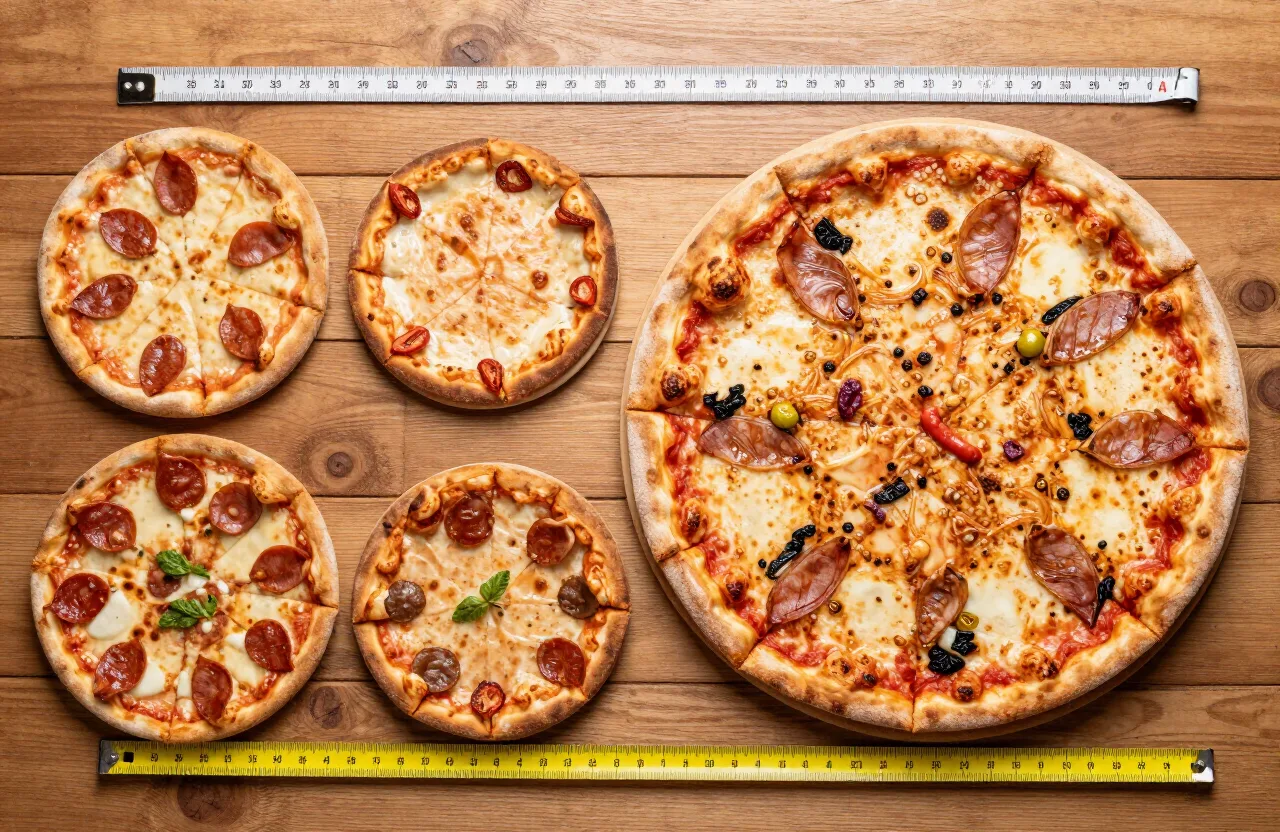
Pizza size and slice chart
Standard cuts give a small pizza 6 slices and larger pizzas 8–12. But the real measure is area: a 16-inch pizza has roughly the area of two 12-inch pizzas.
- 10 inch (small): ~78 sq in, 6 slices, feeds 2
- 12 inch (medium): ~113 sq in, 8 slices, feeds 3
- 14 inch (large): ~154 sq in, 8–10 slices, feeds 4
- 16 inch (extra large): ~201 sq in, 10–12 slices, feeds 5
- 18 inch (party): ~254 sq in, 12 slices, feeds 6–7
How much pizza should you order?
A good rule is three slices per adult and two per child. To size a party order precisely, use our calculator's party mode, which converts headcount into the right number of pies.
Is a bigger pizza a better deal?
Almost always. Because area scales with the square of the diameter, larger pizzas give more food per dollar — a 16-inch is usually far better value than two 12-inch pies.
Standard pizza sizes explained
Pizza is sold by diameter, and the common sizes are small (10 inch), medium (12 inch), large (14 inch), and extra-large (16-18 inch). But diameter is deceptive: because area grows with the square of the radius, an 18-inch pizza has more than three times the food of a 10-inch one, not less than twice as much. That math is why larger pizzas are almost always the better value per square inch.
How many slices in a large pizza (and every other size)
A large pizza is usually 14 inches and cut into 8 slices, though some chains cut a large into 10. A medium is 12 inches with 8 slices, a small is 10 inches with 6, and an extra-large is 16 to 18 inches with 10 to 12. Slice counts are a cutting convention, not a measure of food: a large slice is about 50 percent bigger than a medium slice, because a 14-inch pizza has 154 square inches to a 12-inch pizza's 113.
Slice counts are conventions, not laws, but most pizzerias cut to a standard. A small usually yields 6 slices, a medium 8, a large 8-10, and an extra-large 10-12. Tavern-style party cuts produce far more, smaller squares. When ordering for a group, think in total slices rather than number of pies.
- Small (10"): about 6 slices, feeds 1-2.
- Medium (12"): about 8 slices, feeds 2-3.
- Large (14"): 8-10 slices, feeds 3-4.
- Extra-large (16-18"): 10-12 slices, feeds 4-6.
How much pizza to order per person
A common planning rule is three slices per adult and two per child, adjusted for appetite and whether there are sides. For a party, our dough calculator's party mode does this math for you, converting headcount into the number of pies and the total dough weight you'll need. Order slightly more than you think - cold leftover pizza is rarely wasted.
Matching dough weight to size
Behind every pizza size is a target dough-ball weight. A 12-inch Neapolitan or NY pie typically uses a 250-280g ball; scale up proportionally to area for larger pies. Getting the ball weight right is what keeps the crust thickness consistent from one size to the next - use the calculator to convert any diameter into the correct dough weight.
The math behind pizza value
Because area scales with the square of the radius, jumping up a size adds far more pizza than the diameter suggests. A 16-inch pizza has roughly 1.8 times the area of a 12-inch, and an 18-inch has more than twice the food of a 12-inch. That's why the largest size is almost always the best price per square inch, and why two mediums often give you less pizza than one extra-large despite feeling like more.
Personal, sharing, and family sizes
Think in terms of purpose rather than just inches. A 10-inch personal pizza suits one hungry adult; a 12-inch medium works for two sharing with sides; a 14-inch large feeds a small family; and a 16-18 inch extra-large or two pies covers a gathering. When mixing toppings for a group, ordering two smaller pizzas can beat one large pie for variety even if it costs a little more per slice.
Ordering the right amount for any group
The safest approach to ordering for a group is to plan around total slices rather than number of pizzas, using roughly three slices per adult and two per child as a baseline, then adjusting for appetite and sides. Mixing a couple of sizes and toppings gives variety, and erring slightly high means welcome leftovers rather than hungry guests. For home baking, the dough calculator's party mode converts your headcount straight into dough balls and total flour so you prep exactly what you need.
Frequently Asked Questions
How many slices are in a 12 inch pizza?
A 12-inch pizza is typically cut into 8 slices and feeds about three people.
How big is a 14 inch pizza?
A 14-inch pizza is about 154 square inches, usually cut into 8–10 slices and feeds around four people.
How many people does a 16 inch pizza feed?
A 16-inch pizza has about 201 square inches, gives 10–12 slices, and feeds around five people.
Is it cheaper to buy a bigger pizza?
Usually yes — area grows with the square of the diameter, so larger pizzas offer more food per dollar.
How many slices are in a large pizza?
A large pizza is typically 14 inches across and cut into 8 slices. Some pizzerias cut a large into 10 slices, and party cuts produce 12 to 16 squares. Count on 3 slices per adult when ordering.