
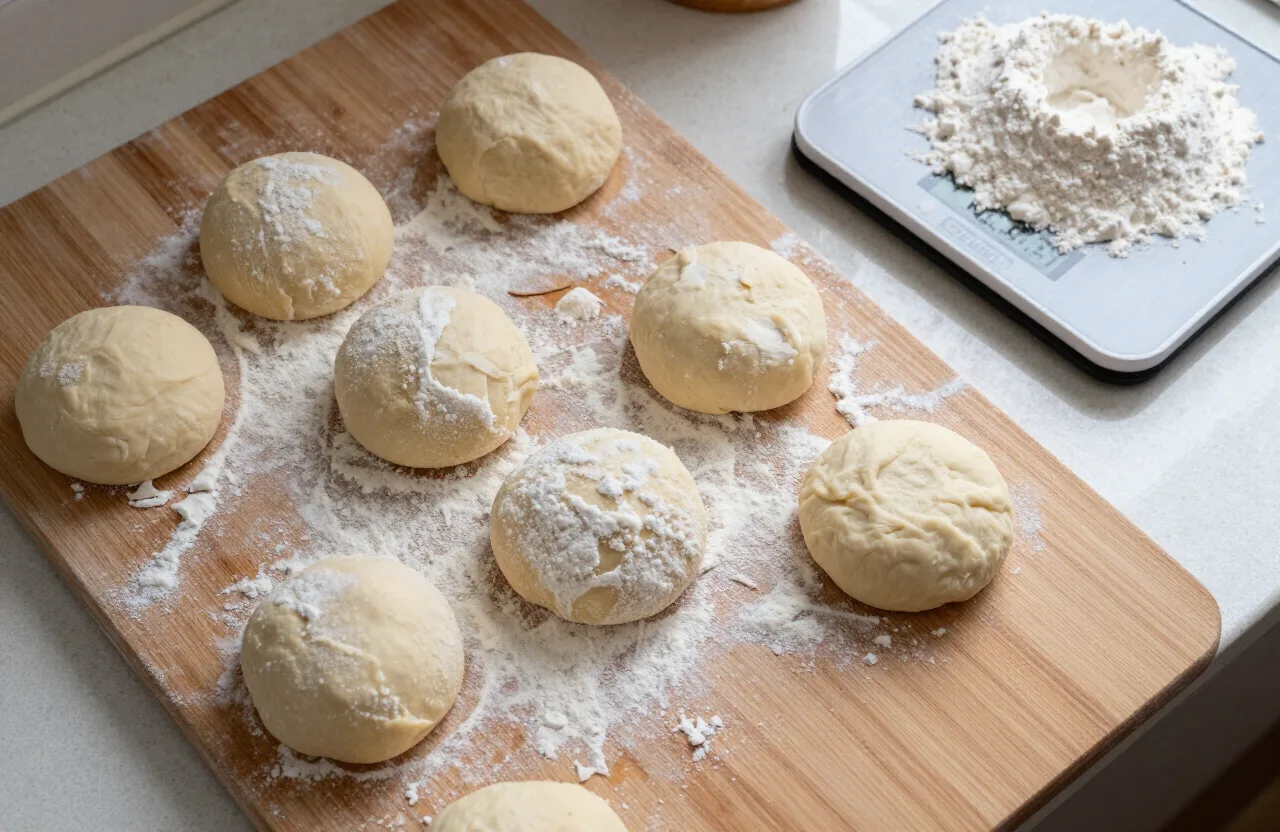
Pizza dough recipes on this page
Beyond Neapolitan, our library covers a high-gluten New York dough (62% hydration, overnight cold ferment), a cracker-thin tavern dough, a tangy sourdough discard dough, a fast no-yeast dough using baking powder, and a gluten free blend. All use gram weights for consistency.
- New York style: 62% hydration, overnight cold ferment
- Thin/tavern: ~50% hydration, rolled and docked
- Sourdough discard: fold discard into a 65% dough
- No-yeast: baking powder dough, ready in 20 minutes
How to make pizza dough at home: the four ingredients
Pizza dough is flour, water, salt, and yeast - yet those four ingredients, in different ratios and with different handling, produce every style on earth. Flour supplies gluten and structure; water hydrates the flour and controls the crumb; salt strengthens the gluten and seasons the dough; yeast ferments the dough, creating flavor and lift. Master the ratios and you can build any dough from scratch.
Everything else - poolish, biga, sourdough starter, oil, sugar, or malt - is a refinement layered on top of that foundation to add flavor, extensibility, or browning.
- Neapolitan pizza dough recipe
- Easy pizza dough recipe (same-day)
- No-yeast pizza dough
- Sourdough pizza crust
- New York style dough
- Gluten free dough
Choosing your flour
Flour protein content dictates chew. Italian 00 flour is finely milled with moderate protein, ideal for the tender, extensible dough of Neapolitan pizza baked in a very hot oven. Higher-protein bread flour builds the stronger gluten network that gives New York slices their signature chew and fold. All-purpose flour works in a pinch but yields a softer, less structured crust.
- 00 flour: Neapolitan, high-heat ovens, tender and extensible.
- Bread flour: New York and pan styles, chewy and strong.
- All-purpose: acceptable for beginners, softer result.
- Whole wheat / rye blends: nuttier flavor, add water to compensate.
The power of slow fermentation
Time is the secret ingredient. A cold, slow fermentation of 24-72 hours in the refrigerator develops complex, faintly sour flavor and a more digestible, open crumb that no same-day dough can match. Pre-ferments like poolish (equal parts flour and water with a little yeast) and biga (a stiffer version) build even more flavor and strength before you mix the final dough.
If you're short on time, a same-day dough with a few hours of room-temperature rise still makes good pizza - but if you can plan ahead, an overnight cold ferment is the single biggest upgrade to homemade dough.
Handling, balling, and proofing
After mixing, let the dough bulk-ferment, then divide it into individual balls sized for your pizza - roughly 250-280g for a 12-inch Neapolitan or NY pie. Ball them tightly to build surface tension, then proof until relaxed and puffy. A well-proofed ball stretches easily without tearing or snapping back; an under-proofed one fights you and springs closed.
Stretching without tearing
Never use a rolling pin - it crushes the gas bubbles that make the crust light. Instead, press the dough from the center outward with your fingertips, leaving a raised rim, then stretch it over your knuckles or drape it and let gravity thin it. Work on a lightly floured surface and move quickly so the dough doesn't stick, and use the dough calculator to get your ball weights exactly right for the size you want.
Troubleshooting common dough problems
Most dough failures trace back to a handful of causes. Dough that tears when you stretch it is usually under-proofed or too cold - let it rest and warm up. Dough that snaps back and won't hold its shape has tight gluten that needs more relaxation time. A dense, flat crust points to under-fermentation or dead yeast, while a dough that overflows its container and smells boozy has over-fermented and should be used quickly or discarded.
Same-day, overnight, and sourdough schedules
Choose a fermentation schedule that fits your day. A same-day dough with more yeast is ready in four to six hours for spontaneous pizza. An overnight cold ferment (24-48 hours) develops the best balance of flavor and convenience for most cooks. A sourdough or long-biga dough over two to three days delivers the deepest, most complex flavor for those willing to plan ahead and maintain a starter.
- Same-day: higher yeast, 4-6 hours, convenient but simpler flavor.
- Overnight cold ferment: 24-48 hours, the best all-round choice.
- Sourdough / long biga: 2-3 days, deepest flavor, most planning.
Freezing dough for later
Pizza dough freezes well, so make a big batch and stash extras. After balling, lightly oil each ball, seal it in an airtight bag or container, and freeze for up to three months. Thaw overnight in the fridge and then let it come to room temperature for an hour or two before stretching. Freezing pauses fermentation, so freeze the dough once it's been shaped into balls rather than after a long proof.
Bringing it all together on bake day
With your dough mixed, fermented, and balled, bake day comes down to a few key moves. Pull the dough from the fridge an hour or two ahead so it warms and relaxes, making it far easier to stretch. Preheat your steel, stone, or oven fully. Shape gently by hand without a rolling pin, keeping the rim raised, then top with a light hand and bake hot and fast. Let each pizza rest a minute before slicing so the cheese sets.
Above all, keep records. Note your flour, hydration, salt, yeast, fermentation time, and bake, and adjust one variable at a time. The dough calculator locks in your gram weights so every batch starts from the same reliable baseline, turning great pizza from a happy accident into something you can repeat on demand.
Baking for someone who avoids gluten? The gluten-free pizza crust recipe swaps the gluten network for psyllium husk and still bakes on the same steel.
Neapolitan pizza dough recipe
The classic Neapolitan pizza dough: a high-hydration '00' flour dough, long cold-fermented for an open, blistered crust that bakes in under 90 seconds in a very hot oven. Makes four 250g dough balls.
Yield: Four 250g dough balls
Ingredients
- •600g '00' flour
- •390g water (65% hydration)
- •18g salt
- •1g instant yeast
Method
- 1Dissolve salt in the water, then mix in flour and yeast until no dry flour remains.
- 2Knead 8–10 minutes to a smooth, elastic dough; rest 20 minutes.
- 3Bulk ferment 2 hours at room temperature, then divide into four 250g balls.
- 4Cold-ferment the balls 24 hours, then bring to room temp before stretching.
- 5Bake as hot as possible — ideally 800°F+ in a pizza oven for 60–90 seconds.
Easy pizza dough recipe (same-day, 4 hours)
This is the easy pizza dough recipe for a weeknight: more yeast and a short warm rise, so it is ready about four hours after you start. It will not have the depth of a cold-fermented dough, but it bakes up light and crisp and it is forgiving. Makes two 250g balls, enough for two 12-inch pizzas.
Yield: Two 250g dough balls
Ingredients
- •300g bread flour
- •186g lukewarm water (62% hydration)
- •6g fine sea salt
- •3g instant yeast (1 teaspoon)
- •6g olive oil
Method
- 1Stir the yeast into the water. Add the flour and salt and mix until no dry flour remains. Rest 10 minutes.
- 2Add the oil and knead 6 to 8 minutes until smooth and slightly tacky.
- 3Cover and rise at warm room temperature for 2 hours, until doubled.
- 4Divide into two 250g balls, cover, and proof 1.5 to 2 hours until puffy.
- 5Stretch and bake on a preheated steel or stone at your oven's maximum temperature for 7 to 10 minutes.
No-yeast pizza dough (ready in 20 minutes)
A no-yeast pizza dough uses baking powder for lift, so there is no rise to wait for. The texture is closer to a thin, crisp flatbread than a chewy pizzeria crust, which makes it a good match for thin crust and tavern-style toppings. Makes one 12-inch pizza.
Yield: One 12-inch pizza
Ingredients
- •250g all-purpose flour
- •10g baking powder (2 teaspoons)
- •4g fine sea salt
- •150g water
- •15g olive oil
Method
- 1Whisk the flour, baking powder and salt together. Add the water and oil and mix into a shaggy dough.
- 2Knead for 2 minutes, just until it comes together. Over-kneading makes it tough.
- 3Rest 10 minutes under a towel so the flour hydrates.
- 4Roll thin on a floured surface, dock with a fork, top lightly and bake at 475°F (245°C) on a preheated steel or stone for 10 to 12 minutes.
Sourdough pizza crust (discard method)
This sourdough pizza crust uses discard for flavor and a pinch of instant yeast for reliable rise, so it works even when your starter is not at peak. Expect a tangy, open crumb with blistered edges. Makes two 270g balls, enough for two 12-inch pizzas.
Yield: Two 270g dough balls
Ingredients
- •275g bread flour
- •100g sourdough discard (100% hydration)
- •150g water (about 61% total hydration)
- •6g fine sea salt
- •2g instant yeast
- •8g olive oil
Method
- 1Dissolve the discard and yeast in the water. Add the flour and salt and mix until no dry flour remains. Rest 20 minutes.
- 2Add the oil and knead 5 to 7 minutes until smooth.
- 3Bulk ferment at room temperature for 2 hours, folding the dough over itself once at the 1-hour mark.
- 4Divide into two balls, place in lightly oiled covered containers, and cold ferment in the fridge for 24 to 72 hours.
- 5Take the balls out 1.5 to 2 hours before baking. Stretch and bake on a preheated steel or stone at maximum temperature for 7 to 10 minutes.
Frequently Asked Questions
What is the best pizza dough recipe?
For most home bakers, a 65% hydration Neapolitan dough with a 24-hour cold ferment gives the best flavor and texture.
What hydration should pizza dough be?
Neapolitan runs about 62–65%, New York around 60–62%, and tavern-style around 50%.
Can you make pizza dough without yeast?
Yes — a baking powder dough comes together in about 20 minutes, though it won't have the same chew as a yeasted dough.
How do you scale a pizza dough recipe?
Use the pizza dough calculator to set your ball count, size, and hydration — it outputs exact gram weights.
Is a pizza crust recipe the same as a pizza dough recipe?
Yes. Pizza crust and pizza dough recipes are the same thing: the dough is what you mix and ferment, and the crust is what it becomes in the oven. Every pizza crust recipe on this page can be scaled to any pan size with the dough calculator.