
Supreme Pizza: What's Actually On It (and How to Build a Better One)
Pepperoni, sausage, peppers, onions, mushrooms and olives — what a supreme actually is, why the combination works, and how to keep it from going soggy.
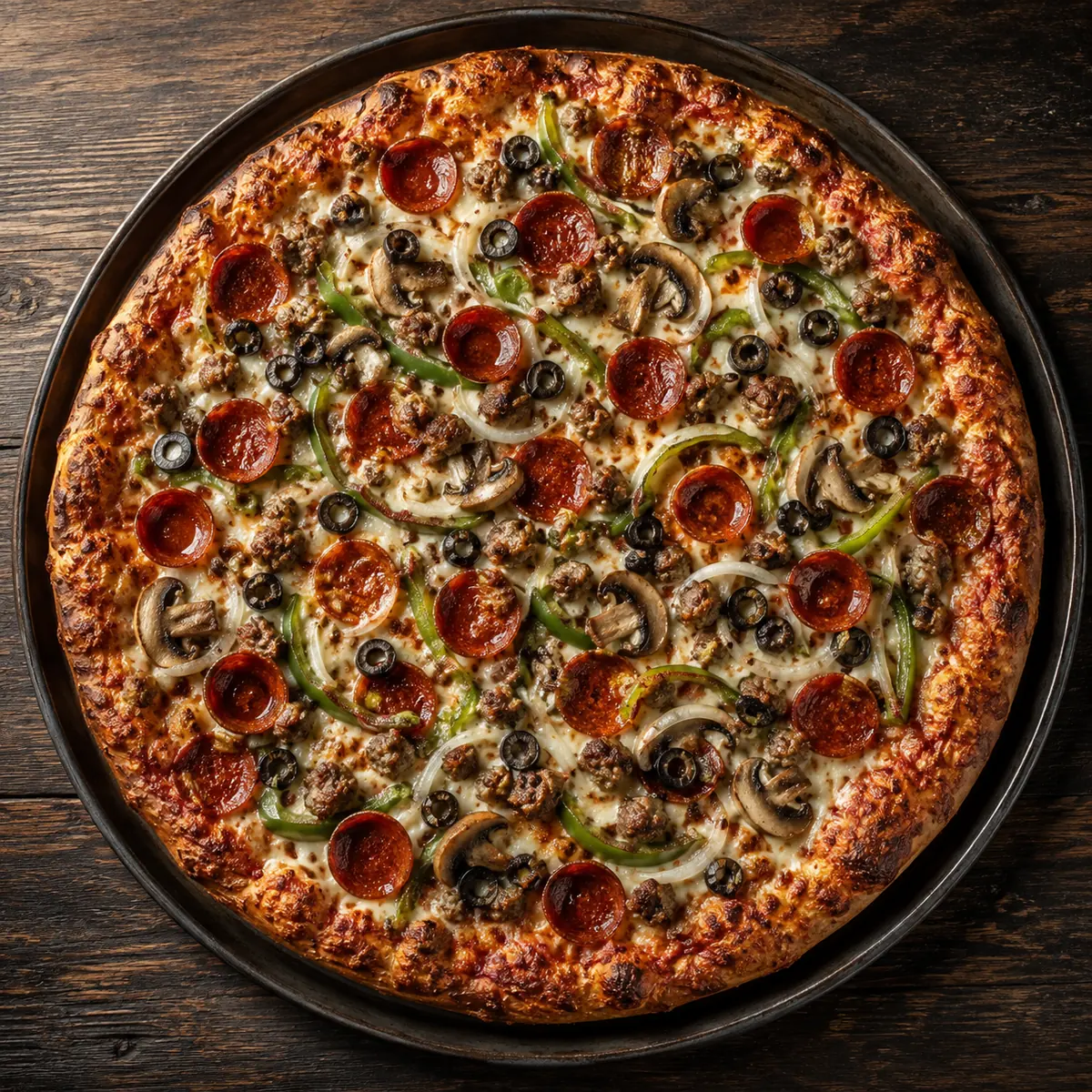
A supreme pizza is a red-sauce pizza topped with pepperoni, Italian sausage, green bell peppers, onions, black olives, and mushrooms over mozzarella. That five-to-six topping combination — two meats, three or four vegetables — is what almost every American pizzeria means by "supreme," even though no legal or traditional definition exists. It is the default answer to "put everything good on it." The name suggests excess, but the best version is not a chaotic pile. It is a carefully balanced pizza in which every topping has a job, and the order and quantity matter as much as the ingredient list.
The standard supreme pizza toppings
The canonical build starts with tomato sauce, followed by low-moisture mozzarella, then the toppings in this order: pepperoni, crumbled Italian sausage, green bell pepper, onion, mushrooms, and black olives. That sequence is a useful shopping list and a sensible way to think about the finished pie, even though a pizzaiolo may scatter everything in a different order. Low-moisture mozzarella gives the toppings a cohesive, browned layer without the excess water of fresh mozzarella.
There is plenty of regional and chain-level variation. Some shops add banana peppers for a sharper, pickled note. Others swap black olives for green olives, add ham, or use diced tomatoes. The through-line is balance: salty cured meat from the pepperoni, savory fresh meat from the sausage, sweetness from onion and green pepper, earthiness from mushroom, and a concentrated brine from the olive. If those flavors are present, customers generally recognize the pizza as supreme even when the exact toppings differ.
- Tomato sauce: a bright, acidic base that keeps the rich toppings from feeling heavy.
- Low-moisture mozzarella: the mild, stretchy binder that browns well.
- Pepperoni and Italian sausage: the salty and savory meat foundation.
- Green pepper, onion, and mushrooms: sweet, vegetal, and earthy counterpoints.
- Black olives: a small but important hit of salt and brine.
What each chain puts on a supreme
Major chains use the word consistently enough to make a useful comparison, but their recipes show why it is worth checking the menu description. Pizza Hut Supreme includes pepperoni, pork, beef, green pepper, red onion, and mushroom. Domino's ExtravaganZZa is the most loaded of these examples: pepperoni, ham, Italian sausage, beef, onion, green pepper, mushroom, and black olive. Domino's Deluxe is the lighter version. Papa John's The Works has pepperoni, sausage, onion, green pepper, mushroom, and black olive. Little Caesars Ultimate Supreme uses pepperoni, sausage, mushroom, green pepper, and onion.
Those menus also explain why people can disagree about what comes on a supreme pizza. One chain may count beef or ham as part of its signature build, while another keeps the meat to pepperoni and sausage. If a menu simply says "supreme," assume pepperoni, sausage, pepper, onion, and mushroom, and ask about olives. That quick question is especially useful when ordering for someone with an olive allergy or a strong preference about cured toppings.
Why the supreme combination works
A supreme is a flavor structure, not a random pile. Pepperoni cups and crisps in the oven, releasing paprika-stained fat across the cheese. That fat carries its spice into nearby vegetables and gives the crust little concentrated savory spots. Sausage brings fennel and coarse fat, so it reads richer and rounder than pepperoni's sharper cured flavor. Together, the meats provide contrast rather than simply doubling down on salt.
Green pepper and onion add sweetness and a fresh vegetal bite that cuts through the fat. Their aromatics become softer and sweeter as they cook, but they retain enough edge to keep each bite moving. Mushrooms contribute glutamates, the same savory compounds that make aged cheese and tomatoes taste deep and satisfying. Black olives add concentrated salt and acidity, which is why a few slices can wake up a bite that has a lot of cheese and meat.
Remove any one element and the pizza tilts. Without pepperoni, the sausage can feel one-dimensional. Without the pepper and onion, the meat becomes heavy. Without mushrooms, the pie loses earthy depth; without olives, it loses its briny punctuation. The combination works because it alternates richness with sweetness, savoriness with freshness, and soft toppings with crisp edges. That is also why using the same weight of every topping does not improve it: balance depends on proportion.
The problem with supreme pizza — and how to fix it
A supreme goes soggy faster than almost any other pizza because peppers, onions, and mushrooms are mostly water. Six toppings' worth of moisture releases into the cheese during the bake. Raw sausage adds more fat and water, while a crowded surface blocks the heat that should be drying the dough. The result can be a beautifully browned top sitting over a pale, damp center. Three simple fixes make a much bigger difference than adding more heat at the last second.
- Pre-cook the wet vegetables. Sauté the peppers, onions, and mushrooms until they give up their liquid and start to brown. Let them cool briefly before they go on the dough. This concentrates their flavor and removes the water most likely to pool under the cheese.
- Brown and drain the sausage first. Raw sausage releases fat and water during the bake and may not cook through in a short, hot pizza bake. Brown it in a skillet, break it into small crumbles, and follow the USDA's sausage safety guidance for a safe internal temperature before draining it well. Use the rendered fat for another purpose or discard it.
- Use less of everything. Aim for about 60% surface coverage, not 100%. You should still see small windows of cheese and sauce between toppings. A lighter single layer cooks more evenly and gives the crust room to vent steam.
Finally, bake hot on a fully preheated baking steel or stone at the oven's maximum temperature. Give the steel or stone at least 45 minutes to absorb heat. A hot floor sets the base before the toppings weep, which is the difference between a loaded pizza with structure and one that needs to be eaten with a fork.
How to make a supreme pizza at home
This tested home formula makes one 12-inch pizza. For a reliable starting point, use a 250g dough ball; if you are scaling for a party, the pizza dough calculator can help you adjust the batch without changing the texture.
Ingredients
- 1 250g dough ball
- 80g pizza sauce
- 170g shredded low-moisture mozzarella
- 15–18 pepperoni slices
- 85g Italian sausage, browned and drained
- ⅓ green bell pepper, sliced and sautéed
- ⅓ onion, sliced and sautéed
- 60g mushrooms, sliced and sautéed
- 20g sliced black olives
Method
- Preheat the oven with a steel or stone at its maximum temperature for 45 minutes. Sauté the pepper, onion, and mushrooms separately or together until softened, lightly browned, and no longer wet. Brown and drain the sausage.
- Stretch the dough into a 12-inch round, keeping a slightly thicker rim. If you need a refresher on dough weight and hydration, compare the results with the dough calculator before you start.
- Sauce thinly to within a half-inch of the edge. Add the mozzarella, then distribute the sausage and vegetables in an even single layer. Put the pepperoni on last so its edges have direct exposure to the heat and crisp properly. Scatter the olives into the gaps rather than making a dense cluster.
- Launch the pizza onto the preheated surface and bake for 6–10 minutes, until the crust is browned, the cheese is bubbling, and the pepperoni edges have curled. Exact time depends on the oven's maximum temperature and how much heat your steel or stone holds.
- Rest the pizza on a wire rack for two minutes before cutting. Cutting immediately releases steam into the crust, while a short rack rest lets the base firm up without trapping condensation underneath.
For the cheese choice, see our guide to the best cheese for pizza. The low-moisture whole-milk mozzarella recommended there is especially helpful here because a supreme already carries more moisture than a plain pie.
Supreme pizza calories and nutrition
A slice from a 14-inch supreme runs roughly 280–330 calories, above plain cheese at about 240–285 calories but in the same range as most meat pizzas. The vegetables add fiber and volume without much energy; the increase comes almost entirely from the second meat and the extra cheese needed to hold six toppings. Slice size, crust thickness, sausage type, and the restaurant's portioning can move those numbers substantially, so treat them as a practical range rather than a laboratory value.
For ingredient-level comparisons, check the USDA's FoodData Central and add the dough, sauce, cheese, meats, and vegetables separately. That approach is more useful than assuming every restaurant's "supreme" has the same amount of sausage or mozzarella. A smaller slice with a thin crust can be a reasonable portion, but the toppings do not make the pizza nutritionally equivalent to a vegetable-only pie.
Supreme on other pizza styles
The format changes how successfully a supreme carries its toppings. Sicilian or pan pizza has the thick, sturdy base that handles the weight best and is arguably the ideal format for a fully loaded pie. Its crumb can absorb some rendered fat and vegetable moisture without collapsing. The tradeoff is a longer bake and a heavier overall slice.
Tavern style has a cracker-thin base that cannot support six full portions, so halve the quantities and keep the toppings very finely sliced. Hand tossed is the chain default and a reasonable middle ground: sturdy enough for the classic build, but still light enough to stay crisp. Neapolitan does not work well with a traditional supreme. In a 90-second bake, the vegetables never cook properly and the center floods. Save the full combination for a style with enough time and structure to support it.
Frequently asked questions
What is on a supreme pizza?
Pepperoni, Italian sausage, green bell pepper, onion, mushrooms, and black olives over tomato sauce and mozzarella. Some versions add ham, beef, or banana peppers.
What's the difference between a supreme and a deluxe pizza?
They usually mean the same thing. Where a menu carries both, "deluxe" tends to be the lighter build and "supreme" the fully loaded one.
Is a supreme pizza vegetarian-friendly?
No — it contains two meats by definition. Ordering one without pepperoni and sausage gives you a veggie pizza, which most shops list separately.
Why does my homemade supreme pizza come out soggy?
Too much moisture from raw vegetables is the usual reason. Sauté the peppers, onions, and mushrooms first, brown and drain the sausage, and use fewer toppings overall. A fully preheated steel or stone also helps the base set before steam accumulates.
What cheese is best on a supreme pizza?
Low-moisture whole-milk mozzarella. It browns properly and releases less water than fresh mozzarella. It also has enough mild dairy flavor to support the meats and vegetables without competing with them.
How many toppings make a pizza a supreme?
There is no fixed number, but five is the practical minimum — two meats and three vegetables. In everyday American pizza language, the recognizable core is pepperoni, sausage, pepper, onion, and mushroom, with black olives often included as the sixth topping.