
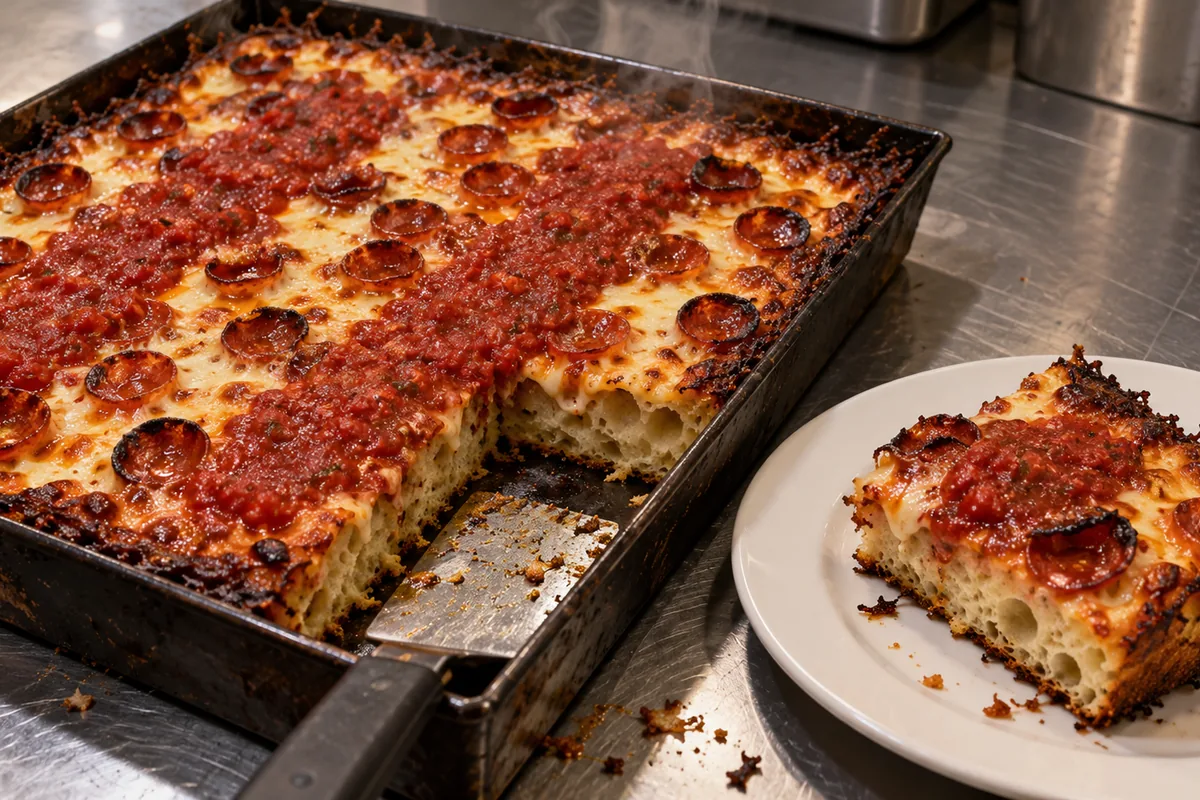
What is Detroit style pizza?
Detroit style pizza is a deep, square-cornered pan pizza, usually 8 by 10 or 10 by 14 inches, with four defining features. The crust is thick but open and light, closer to focaccia than to a dense deep dish. The cheese, traditionally Wisconsin brick, is cubed and spread to the very edge of the pan, where it melts down the sides and caramelizes against the hot steel into a crunchy, lacy border that pizzerias call the frico edge. The sauce goes on top of the cheese, in two or three stripes, so it stays bright and the crust under it stays dry. And the whole thing is baked hard, in a dark steel pan, so the bottom comes out fried and crisp rather than bready.
The result is a pizza you judge by its corners. On an 8-slice pie, four squares have two walls of caramelized cheese, and people fight over them. Our pizza styles atlas puts it alongside the other American pan pizzas; this page goes deep on the one from Michigan.
What goes on a Detroit style pizza, in order
The build is upside down compared with a round pizza, and the order is the whole point.
- Dough: a high-hydration, no-oil, no-sugar dough pressed into an oiled pan and allowed to rise a second time until it fills the corners.
- Pepperoni first: pressed straight onto the dough, under the cheese, so it stays moist and its fat soaks into the crust rather than sitting on top. Buddy's, the originator, still does it this way.
- Cheese: brick cheese cut into small cubes, covering the top edge to edge and heaped along the pan walls. That wall of cheese is what becomes the crisp edge.
- Sauce on top: a cooked, seasoned tomato sauce spooned in two or three stripes down the length of the pizza, either before the bake or, at some shops, ladled on hot after it comes out. The stripes are called racing stripes in Detroit, and a plain cheese version with sauce on top is a red top.
- Anything else: cupped pepperoni on top for crunch, pickled peppers, a dusting of grated Parmesan or Romano. Toppings stay sparse, because the crust and the cheese edge are the attraction.
The pairing rules for everything else you might add are on our pizza toppings page.
Detroit style pizza dough spec
Same spec card we use for every style in the atlas. The numbers below scale in the dough calculator, which has a Detroit preset.
- Flour: bread flour, 12.5 to 13.5 percent protein. All-purpose works but gives a softer, less chewy crumb.
- Hydration: 70 to 75 percent. This is a wet, slack dough you press rather than stretch.
- Oil in the dough: none. The oil goes in the pan, generously.
- Sugar: none.
- Salt: 2 percent.
- Yeast: 0.3 to 0.5 percent instant for a same-day dough; less for an overnight cold rise.
- Ferment: 2 to 3 hours bulk at room temperature, then 1 to 2 hours in the pan; or 24 to 48 hours cold, then 2 hours in the pan to warm and rise.
- Dough weight: 450 to 500 grams for a 10 by 14 inch pan; 280 to 300 grams for an 8 by 10.
- Shape: pressed into the oiled pan with oiled fingertips, rested, pressed again to the corners. Never rolled.
- Cheese: 250 to 300 grams brick cheese, cubed, for a 10 by 14; spread to the walls.
- Sauce: 200 to 250 grams cooked, thick tomato sauce, in stripes on top.
- Bake: 500 to 550°F, lowest rack, 14 to 18 minutes, dark steel or anodized aluminum pan.
- Cut: 8 squares on a 10 by 14 (two rows of four), 4 to 6 on an 8 by 10.
- Origin: Buddy's Rendezvous, Detroit, 1946.
Make this style: open the calculator with the Detroit preset
Where Detroit style pizza came from
In 1946 Gus Guerra, who ran a neighborhood bar called Buddy's Rendezvous at Six Mile and Conant on Detroit's east side, started baking a square, Sicilian-influenced pizza for the after-work and returning-veteran crowd. The pans were the accident that made the style. Buddy's own history says they were forged steel pans from local automotive plants; a trade account in Restaurant Business describes them as rectangular blue steel pans that auto suppliers had been using, passed along by a supplier. Either way they were heavy, dark and seasoned deeper with every bake, which is exactly what a crisp bottom and a caramelized cheese edge need. Buddy's still describes its dough as double proofed and stretched twice in the pan, with the toppings layered in reverse order.
For decades it stayed a Detroit thing. Jet's Pizza, founded in Sterling Heights in 1978 by Eugene and John Jetts, grew the square pie into a franchise that now counts more than 400 stores in 25 states. Little Caesars, also a Detroit company, put its Detroit-style Deep! Deep! Dish on sale nationwide in April 2013. Pizza Hut launched a Detroit-Style pizza across the country on January 26, 2021, after what it said were more than 500 test versions, and that is the moment the style stopped being regional. Our history of pizza page follows the longer American story, from the first New York slice shops to the pan pizzas of the Midwest.
Detroit vs Chicago deep dish vs Sicilian: how the pan pizzas differ
People lump every thick square pizza together, and the three big American pan styles are built on different ideas. Detroit is cheese-to-the-edge and sauce on top. Chicago deep dish is a buttery, pie-like crust pressed up the sides of a round pan with cheese on the bottom, toppings in the middle and chunky tomato sauce covering everything. Sicilian, in its American form, is a rectangular sheet-pan pizza with a soft, bready crust and a conventional sauce-then-cheese order.
| Style | Pan | Crust | Order of layers | Bake | Defining detail |
|---|---|---|---|---|---|
| Detroit style | 8x10 or 10x14 rectangular steel, 2.5 inches deep | Thick, airy, fried bottom, 1 to 1.5 inches | Pepperoni, cheese to the edge, sauce stripes on top | 500 to 550°F, 14 to 18 minutes | Caramelized brick cheese edge |
| Chicago deep dish | Round, 2 inches deep, often 9 or 10 inches | Short, biscuit-like, pressed up the sides | Cheese slices, toppings, chunky sauce on top | 425 to 450°F, 30 to 40 minutes | Eaten with a fork; see our deep dish pizza guide |
| Sicilian (American) | Half or full sheet pan | Thick, soft, bready, 1 inch | Sauce, then cheese, toppings on top | 450 to 500°F, 18 to 25 minutes | Square slices, often served at room temperature; see Sicilian pizza |
| Grandma pie | Sheet pan, thinner layer of dough | Thin, crisp, olive oil rich | Cheese first, then sauce in dollops | 450 to 500°F, 15 to 20 minutes | Long Island home-style; the thin cousin of Sicilian |
| Tavern style | Pizza screen or stone, round | Cracker thin | Sauce, cheese, toppings | 500°F, 12 to 15 minutes | Chicago's other pizza, party cut; see tavern style |
The Detroit vs Chicago pizza argument is mostly a texture argument. Deep dish is a casserole you eat with a knife and fork, dense and rich and slow to bake. Detroit is lighter than it looks, holds in the hand, and bakes in a quarter of the time. Detroit is sometimes sold as Detroit deep dish, which is a marketing name rather than a kinship; the two styles share a depth and nothing else.
The Detroit style pizza pan
The pan matters more here than in any other style, because the pan is what makes the edge. The originals were blue steel, which is untreated carbon steel that darkens and seasons with use like a cast iron skillet. Modern pizzerias mostly use hard-anodized aluminum pans made for the purpose, 8 by 10 or 10 by 14 inches, about 2.5 inches deep, with straight or slightly angled walls and a dark finish that absorbs heat. LloydPans, the Washington maker that supplies much of the trade, said in December 2022 that the Detroit style pan had become its best-selling pan style of that year, which tells you how far the style had traveled.
At home, you do not need a special pan to start. A 9 by 13 inch metal baking pan with straight sides works for a first batch; use a dark one if you have it, and a light one will give a paler edge. A 10 inch cast iron skillet makes a round Detroit-ish pizza with the same cheese edge. Glass and ceramic dishes do not get hot enough fast enough, and the cheese sticks to them. Whatever you use, oil it heavily, 2 tablespoons for a 10 by 14, since the oil is frying the bottom of the crust.
Brick cheese, and what to use instead
Brick cheese is the Detroit cheese, and it is a Wisconsin cheese. According to the Wisconsin cheesemakers' own account, a Swiss-born cheesemaker named John Jossi invented it in 1877, pressing the curds with bricks to drain the whey, which gave the cheese its shape and its name. It is semi-soft and higher in fat than mozzarella, milder than the Limburger it is related to, and well-aged brick turns sweet and pungent. Young brick is what goes on pizza. It melts creamy, browns well, and when it hits the hot pan wall it renders enough fat to fry itself into that dark, crisp edge without turning to oil the way cheddar does.
Outside the upper Midwest it can be hard to find, so pizzerias and home cooks blend. The closest everyday substitute is low-moisture mozzarella mixed half and half with Monterey Jack, or two parts mozzarella to one part mild white cheddar; both give the fat content the edge needs. Cube the cheese rather than shredding it. Half-inch cubes melt into pools and build the edge; shreds melt flat and burn before the crust is done. Our guide to the best cheese for pizza covers how each of these melts and browns.
Detroit style pizza recipe for a home oven
This is how to make Detroit style pizza in a standard kitchen oven, in one 10 by 14 inch pan or a 9 by 13 baking pan. It is a same-day dough; the total time is about 4 hours, most of it rising. The sauce is a quick cooked sauce, because the stripes on top need body; our pizza sauce page has the longer version and the reasoning. The dough is also on our pizza dough recipes page as the pan dough.
Detroit style pizza recipe (home oven)
This Detroit style pizza recipe uses a same-day, no-oil, 73 percent hydration dough pressed into a heavily oiled 10 by 14 inch pan, brick cheese (or a mozzarella and Monterey Jack blend) cubed and pushed to the pan walls, pepperoni under the cheese, and a cooked sauce spooned on top in stripes. It bakes on the lowest rack of a 500°F oven in about 16 minutes.
Yield: One 10 by 14 inch pizza, 8 squares
Ingredients
- •300g bread flour
- •220g lukewarm water (73% hydration)
- •6g fine sea salt
- •3g instant yeast (about 1 teaspoon)
- •3 tablespoons olive oil or neutral oil for the pan
- •60g pepperoni, about 30 small slices, natural casing if you can find it
- •280g brick cheese cut into half-inch cubes, or 140g low-moisture mozzarella plus 140g Monterey Jack
- •1 can (400g) crushed tomatoes
- •1 clove garlic, grated, 1 teaspoon dried oregano, 1/2 teaspoon sugar, 1/2 teaspoon salt and 1 tablespoon olive oil for the sauce
- •Grated Parmesan or Romano to finish, optional
Method
- 1Mix the flour, water, salt and yeast in a bowl with a spoon until no dry flour remains; it will be a shaggy, sticky mass. Cover and rest 20 minutes, then fold it over itself in the bowl a dozen times with a wet hand. Cover and let it rise at room temperature 2 hours, until doubled and bubbly.
- 2Pour 3 tablespoons of oil into a 10 by 14 inch Detroit pan or a 9 by 13 inch dark metal baking pan and spread it over the bottom and up the sides. Turn the dough into the pan, oil your fingertips, and press it toward the corners. It will spring back; stop when it resists, cover, and wait 20 minutes.
- 3Press again, this time all the way into the corners and in an even layer. Cover and let it rise in the pan 60 to 90 minutes, until puffy and about an inch thick.
- 4Make the sauce while it rises. Warm the tablespoon of oil with the garlic for 30 seconds, add the tomatoes, oregano, sugar and salt, and simmer 15 to 20 minutes until thick enough to hold a stripe. Cool slightly. You need about 220g; keep the rest for dipping.
- 5Put a rack in the lowest position and heat the oven to 500°F for at least 30 minutes. A baking steel or stone on that rack helps the bottom.
- 6Lay the pepperoni over the dough. Scatter the cheese cubes over the whole surface, then push extra cubes against all four pan walls so the cheese sits between the dough and the metal.
- 7Spoon the sauce on top in two long stripes down the length of the pan (three on a 10 by 14), leaving cheese showing between and around them.
- 8Bake 14 to 18 minutes, until the edge cheese is deep brown and crisp and the top cheese is spotted. Check at 14; if the top is done but the edge is pale, 2 to 3 more minutes.
- 9Within two minutes of taking it out, run a thin spatula around the edge and lift the whole pizza onto a cutting board. Rest 3 minutes, dust with Parmesan if using, and cut into 8 squares: two rows of four.
Common mistakes with Detroit style pizza
A pale, soft edge means the cheese did not reach the pan wall, or the pan was light-colored, or the oven was not hot enough. Push cubes of cheese right up against the metal, all four sides, and bake on the lowest rack so the pan takes heat from below. A dense, tight crumb means the dough was under-risen in the pan or over-handled; let it fill the corners on its own, with two gentle presses an hour apart, and do not knock the air out. A soggy middle is too much sauce or sauce spread as a layer instead of stripes; 200 to 250 grams in stripes is the ceiling for a 10 by 14. A pizza that sticks means not enough oil in the pan or a pan that was not hot when the cheese caramelized; lift the whole pizza out with a thin spatula within two minutes of it leaving the oven, before the cheese edge cools and glues itself down. And cutting in the pan scratches the seasoning you spent three bakes building; move it to a board first.
Frozen and chain Detroit style pizza
Since 2021 you can get a Detroit style pizza almost anywhere. Jet's and Little Caesars keep one on the menu year round, and Pizza Hut's 2021 launch put the style in front of the rest of the country; the chain versions use mozzarella blends rather than brick and bake in conveyor ovens, so the edge is crisp but less deeply caramelized than a pizzeria's. Buddy's has shipped its frozen eight-square pizzas nationwide through Goldbelly since late 2020. Frozen Detroit style pizza is now a supermarket category of its own, and it reheats better than most frozen pizza because the thick crust tolerates an oven; bake it directly on a preheated steel or sheet pan rather than the rack so the bottom crisps. Our best frozen pizza ranking covers which brands are worth the freezer space.
Leftover Detroit squares are the best leftover pizza there is. The crust is thick enough to survive a day in the fridge and the cheese edge re-crisps in a covered skillet over medium heat in 4 to 5 minutes; our how to reheat pizza guide has the method.
Detroit style pizza calories
A 10 by 14 inch Detroit style pizza made to the recipe above, with 480 grams of dough, 280 grams of cheese, 220 grams of sauce and 60 grams of pepperoni, comes to roughly 2,800 to 3,100 calories for the whole pan, or 350 to 390 per square when cut into eight. That is about a third more than a slice of a New York cheese pizza and a third less than a wedge of Chicago deep dish, which puts it where you would expect for a thick pizza with a lot of cheese. Skipping the pepperoni saves about 35 calories a square. Our pizza calories page has the chart for every style, and the thin New York style slice is the comparison most people want.
Frequently Asked Questions
What is Detroit style pizza?
Detroit style pizza is a thick, rectangular pan pizza with a light, airy crust, cheese spread to the pan walls so it caramelizes into a crisp edge, and tomato sauce spooned on top of the cheese in stripes. It was first made at Buddy's Rendezvous in Detroit in 1946 in steel pans from the auto industry.
What is the difference between Detroit style and Chicago deep dish pizza?
Detroit style is rectangular, has a light open crumb, cheese baked to the edge and sauce in stripes on top, and bakes in about 16 minutes. Chicago deep dish is round, has a short, pie-like crust with cheese on the bottom and a thick layer of chunky sauce over everything, and bakes for 30 to 40 minutes.
What cheese is used on Detroit style pizza?
Wisconsin brick cheese, a semi-soft, high-fat cheese invented in 1877, cut into cubes rather than shredded. If you cannot find it, use low-moisture mozzarella blended half and half with Monterey Jack, or two parts mozzarella to one part mild white cheddar.
Why is the sauce on top of a Detroit style pizza?
Putting the sauce over the cheese keeps the thick crust dry and light, and keeps the sauce tasting fresh instead of baking into the dough. The stripes, called racing stripes in Detroit, also leave cheese exposed to brown. Some pizzerias ladle the sauce on hot after the bake.
What pan do you need for Detroit style pizza?
A dark rectangular steel or hard-anodized aluminum pan, 8 by 10 or 10 by 14 inches and about 2.5 inches deep, is the standard. A 9 by 13 inch dark metal baking pan works at home. Avoid glass and ceramic, which do not get hot enough to crisp the cheese edge.
Is Detroit style pizza the same as Sicilian pizza?
No, though it descends from it. Both are rectangular and thick, but Sicilian pizza has a soft, bready crust with sauce under the cheese, while Detroit style has a lighter crust fried in an oiled pan, cheese to the edge, and sauce on top.
How many calories are in Detroit style pizza?
Roughly 350 to 390 calories per square when a 10 by 14 inch pizza is cut into eight, or about 2,800 to 3,100 for the whole pan, based on 480g of dough, 280g of cheese, 220g of sauce and 60g of pepperoni. Chain and frozen versions vary, so check the label.
Sources & Further Reading
- Buddy's Pizza, History of Detroit-Style Pizza (1946, Six Mile and Conant, steel pans from automotive plants)
- Restaurant Business, Buddy's stakes its claim to Detroit-style pizza (blue steel pans, pepperoni under the cheese, sauce stripes)
- Wisconsin Cheese, Widmer's Brick Cheese (John Jossi, 1877, pressed with bricks)
- Pizza Hut, Detroit-Style Pizza nationwide launch, January 26, 2021
- ClickOnDetroit (WDIV), Little Caesars debuts Deep! Deep! Dish pizza nationwide, April 1, 2013
- Jet's Pizza, About Jet's (founded 1978 in Sterling Heights; more than 400 stores in 25 states)
- Pizza Today, Detroit-Style Pans Enter December as Best-Seller (LloydPans, 8x10 and 10x14 anodized aluminum), December 7, 2022
- Detroit Metro Times, Buddy's will now deliver its Detroit-style pizza anywhere in the U.S. (Goldbelly, frozen), December 4, 2020