
Gluten-Free Pizza Crust Recipe: Two Methods, One You Can Shape by Hand
Two gluten-free pizza crust recipes with gram weights: a 20-minute batter crust and a psyllium dough you can shape by hand, plus why par-baking stops the gummy middle.
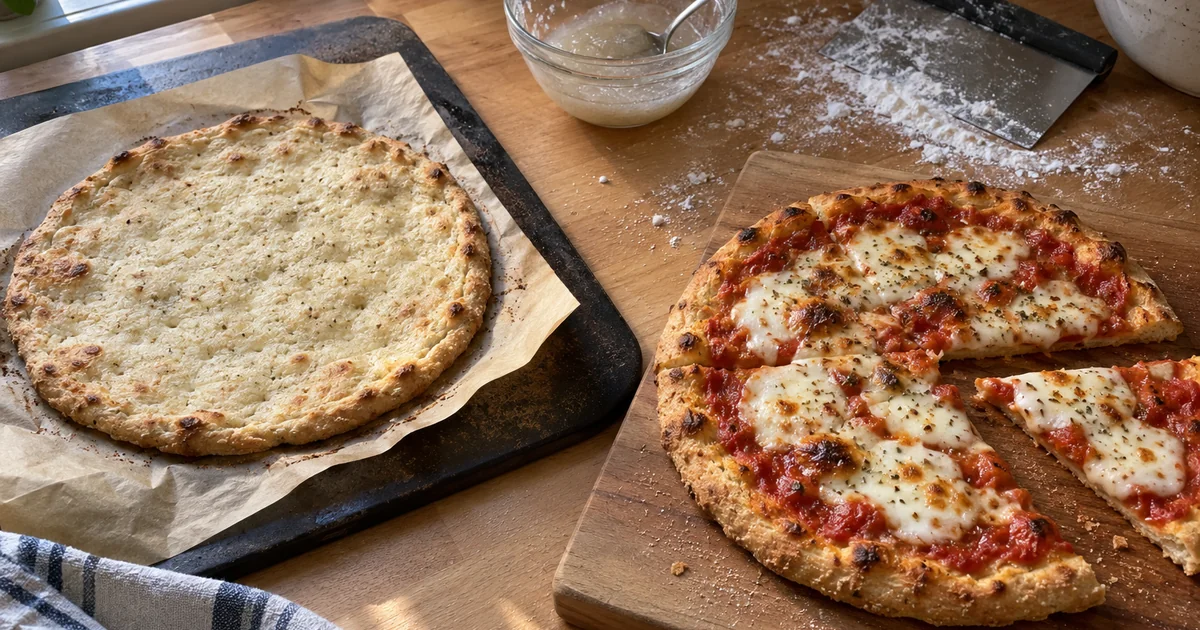
A good gluten-free pizza crust recipe needs two things wheat dough gets for free: a binder to stand in for gluten, and a par-bake to set the base before the toppings go on. Below are two methods. The quick one is a pan-pressed batter that is ready in under an hour. The second uses psyllium husk to make a dough you can shape by hand.
What a gluten-free pizza crust is made of
Gluten is the protein network in wheat, rye and barley that lets dough stretch and trap gas. Take it away and you have to rebuild those jobs with other ingredients. A gluten-free crust is a blend of flours and starches for body (white or brown rice flour, sorghum, millet, tapioca and potato starch), a binder for stretch (xanthan gum or psyllium husk), yeast or baking powder for lift, and more water than a wheat dough would ever take. Under the FDA's labeling rule, anything sold as gluten-free must test below 20 parts per million of gluten, so for a celiac household every bag in the blend needs that label, not just the flour.
The binder decides how the crust behaves, so pick it first:
| Blend | Binder | How it handles | Result | Best for |
|---|---|---|---|---|
| 1:1 gluten-free all-purpose blends (xanthan included) | Xanthan gum | Thick batter, spread with wet hands | Soft, slightly cakey, crisp underneath | Method 1, sheet-pan pizza, beginners |
| Rice flour + tapioca starch + psyllium | Psyllium husk | Real dough, can be pressed and lifted | Chewy edge, thin crisp middle | Method 2, steel or stone |
| Gluten-free "00" pizza flours | Built in | Dough-like, follow the bag | Closest to wheat crust | High-heat ovens |
| Wheat-starch blends (gluten removed) | Built in | Very close to wheat dough | Excellent texture | People avoiding gluten who are not wheat-allergic; check the allergen line |
| Almond or cauliflower bases | Egg and cheese | Pressed, not stretched | Dense, no chew | Low-carb pies, not a pizza-dough substitute |
Our gluten-free pizza guide covers the frozen crusts and chains if you would rather not bake at all.
Method 1: the quick batter crust
This is the style most 1:1 blends are designed for, and it is the approach King Arthur Baking's gluten-free pizza crust takes: a thick, sticky batter beaten with a mixer, pressed into an oiled pan with wet fingers, then par-baked before topping. Makes one 12-inch pizza.
- 240g 1:1 gluten-free all-purpose flour blend with xanthan gum (if your blend has none, add 1 teaspoon)
- 5g salt, 4g instant yeast, 8g sugar, 4g baking powder
- 230g warm water (about 105°F)
- 30g olive oil, plus more for the pan
- Whisk the dry ingredients. Add the water and 15g of the oil and beat with a hand mixer or stand mixer for 3 minutes. It will look like thick frosting, not dough. Cover and rest 30 minutes.
- Heat the oven to 425°F. Oil a 12-inch round pan or a sheet pan with the remaining oil.
- Scrape the batter into the pan and press it out with wet fingertips to a quarter inch thick, slightly thicker at the rim. Rest 10 minutes uncovered.
- Par-bake 10 to 12 minutes, until the top looks dry and the edge is pale gold.
- Add sauce and toppings and bake 10 to 14 minutes more, until the cheese is bubbling and the underside is deep golden when you lift a corner with a spatula.
Method 2: psyllium dough you can shape by hand
Psyllium husk absorbs many times its weight in water and forms a flexible gel, which is the closest thing to a gluten network in a gluten-free kitchen. The dough it makes can be pressed out on parchment, moved on a peel and baked on a steel. America's Test Kitchen built its gluten-free pizza around psyllium and a long, low par-bake to drive out moisture; PBS SoCal reprinted the method, which bakes the bare crusts at 325°F for 45 to 50 minutes before a final bake at 500°F. The version below is faster and leans on a hot steel instead. Makes two 10-inch crusts.
Ingredients
- 200g white rice flour
- 60g tapioca starch
- 40g sorghum flour or brown rice flour
- 12g whole psyllium husk (or 9g psyllium husk powder)
- 6g salt, 4g instant yeast, 8g sugar
- 300g warm water (about 105°F)
- 15g olive oil
- 5g apple cider vinegar (optional; it helps the yeast and softens the crumb)
Method
- Whisk the psyllium into the water and leave it for 5 minutes. It turns into a loose gel.
- Mix the flours, salt, yeast and sugar. Add the gel, oil and vinegar and mix with a spoon, then your hands, until it comes together as a soft, slightly tacky dough. Knead for a minute to even it out. There is no gluten to develop, so a minute is enough.
- Cover and rest 45 to 60 minutes at room temperature. It puffs a little but will not double.
- Put a pizza steel or stone in the oven and heat to 475°F for 45 minutes.
- Divide the dough in two. Press each piece out on a sheet of parchment to a 10-inch round, a quarter inch thick with a thicker rim. Wet fingers stop it sticking. Prick the middle a few times with a fork.
- Slide the parchment and crust onto the steel. Par-bake 7 to 8 minutes, until set and starting to color.
- Top it, sliding the parchment out from underneath at this point if you want more bottom browning, and bake 8 to 10 minutes more.
Both methods scale cleanly. The dough calculator works in grams, so you can set a hydration of 100 percent for Method 2 and let it size the batch for you. Our pizza dough recipes page has the wheat versions for comparison.
Why gluten-free dough is wetter, and why you par-bake
Rice flour and starches hold onto water differently from wheat flour. A gluten-free dough at 70 percent hydration, normal for wheat, bakes up dry and crumbly, so these recipes run between 95 and 110 percent water to flour. All that water is also why the raw crust cannot hold toppings. Sauce and cheese on an unbaked gluten-free base steam the middle and you get a gummy layer under the cheese. The par-bake sets the structure and drives off some moisture first, then the toppings go on for a shorter second bake.
Baking tips that make the difference
- Use parchment. Gluten-free dough tears when you try to lift it bare, and it sticks to a wooden peel. Build it on parchment and launch the parchment.
- Heat from below. A steel on the lowest rack browns the base before the top dries out. Our steel vs stone guide explains why steel wins in a home oven. If you bake on a stone, scrape rather than wash it afterwards; our guide to how to clean a pizza stone covers it.
- Go light on sauce. A gluten-free base is more absorbent than wheat. Two to three tablespoons of pizza sauce on a 10-inch crust is plenty.
- Low-moisture mozzarella. Fresh mozzarella releases water that the crust cannot shrug off. See our guide to the best cheese for pizza.
- Let it rest 3 minutes before cutting. The starches set as they cool, which is the difference between a slice that holds and one that folds in half.
Troubleshooting gluten-free pizza crust
| Problem | Likely cause | Fix |
|---|---|---|
| Gummy layer under the cheese | No par-bake, or toppings too wet | Par-bake until the surface looks dry; drain toppings; less sauce |
| Crust cracks when shaped | Too little water or psyllium not gelled | Add water a tablespoon at a time; give the psyllium its 5 minutes |
| Crumbles when you pick up a slice | No binder, or sliced hot | Check the blend contains xanthan or add it; rest 3 minutes before cutting |
| Pale, soft underside | Oven not hot enough, no steel or stone | Preheat 45 minutes; bake on a steel on the lowest rack |
| Bitter or beany taste | Blend heavy in bean flours | Switch to a rice and sorghum based blend |
| Dense and heavy | Pressed too thick | A quarter inch in the middle, no more |
Keeping it gluten-free for someone with celiac disease
The recipe is only half of it. Wheat flour hangs in kitchen air for hours after someone dusts a counter; Beyond Celiac's cross-contact guide puts it at 12 to 24 hours depending on ventilation. If the same kitchen makes wheat pizza, bake the gluten-free pie first, on its own parchment, on a stone or pan that has not held wheat dough, and wash the peel, cutter and work surface before you start. A porous pizza stone that has had wheat flour burned into it for months is hard to clear, so a dedicated stone or a foil-lined sheet pan is the safer route.
Make ahead and freezing
Par-baked crusts are the best make-ahead in pizza. Cool them fully, stack with parchment between, wrap and freeze for up to a month. Top them straight from the freezer and add 2 to 3 minutes to the final bake. The psyllium dough also keeps, covered, in the fridge for up to two days; let it sit out for 30 minutes before shaping. Leftover slices reheat well in a skillet or an air fryer; our air fryer pizza guide has the times.
Frequently asked questions
What is gluten-free pizza crust made of?
A blend of gluten-free flours and starches, usually rice flour with tapioca or potato starch, a binder such as xanthan gum or psyllium husk to replace gluten's stretch, yeast or baking powder, water, salt and oil.
Why is my gluten-free pizza crust gummy?
Almost always because the crust was topped raw. Gluten-free dough holds far more water than wheat dough and needs a par-bake of 8 to 12 minutes before the sauce and cheese go on. Wet toppings and too much sauce make it worse.
Can you make gluten-free pizza dough without xanthan gum?
Yes. Psyllium husk is the usual replacement and makes a dough you can shape by hand. Use about 12g whole husk or 9g powder per 300g of flour blend and let it gel in the water for 5 minutes before mixing.
Do you need to par-bake gluten-free pizza crust?
For a yeasted or batter crust, yes. The par-bake sets the structure and drives off moisture so the center bakes through instead of steaming under the toppings.
Can gluten-free pizza dough be frozen?
Par-baked crusts freeze well for up to a month and can be topped from frozen. Raw dough is better refrigerated for up to two days than frozen, because freezing breaks down the psyllium gel.
Is gluten-free pizza crust safe for celiac disease?
Only if every ingredient is labeled gluten-free and the crust is made and baked away from wheat flour. Airborne flour, shared pizza stones and shared peels are common sources of cross-contact.